

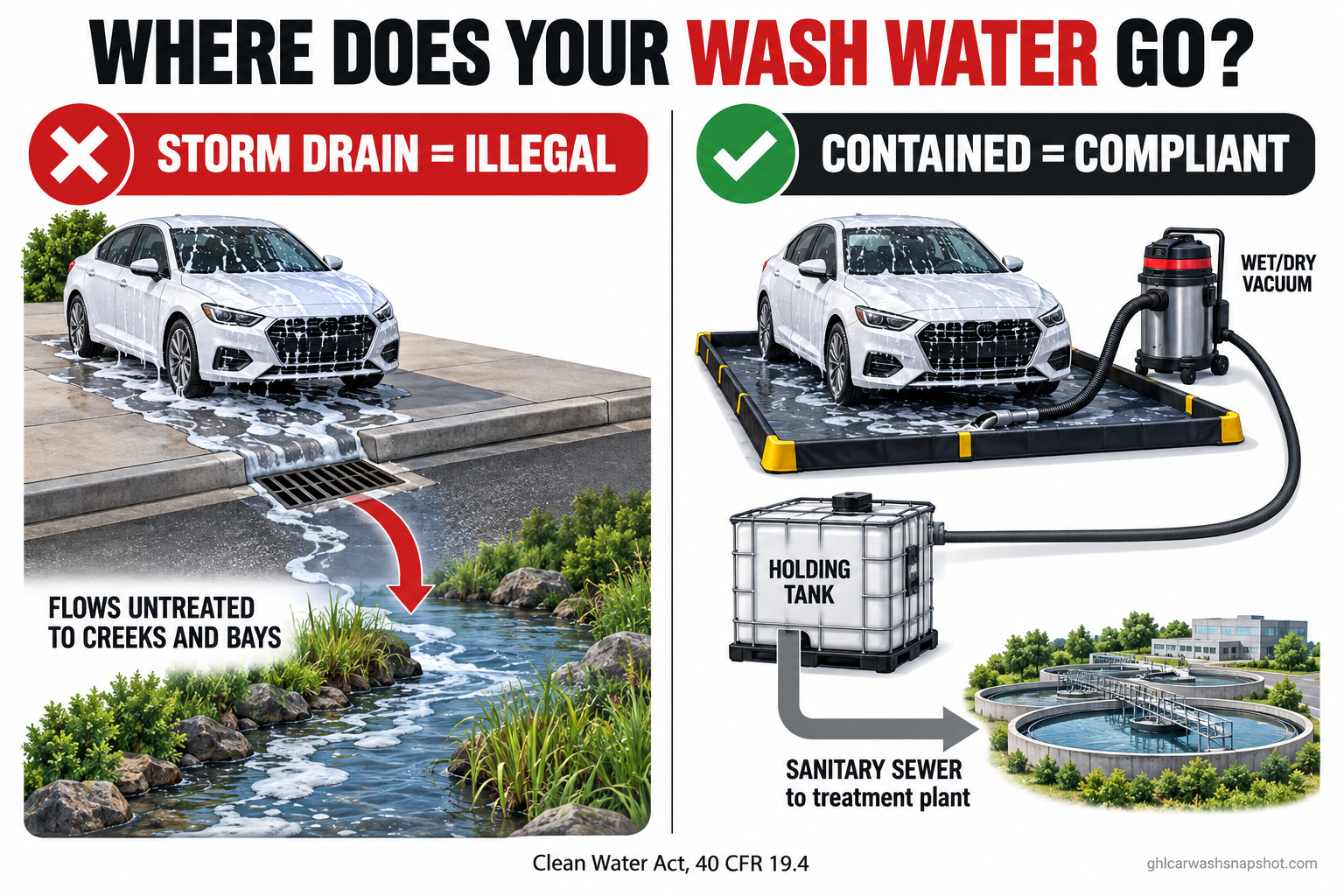
It is a Saturday and you are two cars into a driveway detail when a neighbor films you on her phone. Not the paint correction. The gray water running off the client’s driveway, down the gutter, and into the storm drain at the corner. By Monday a complaint is filed with the city, and the code-enforcement officer who calls does not care that your soap says “biodegradable” on the jug.
Here is the answer up front: in almost every US city, letting detailing wash water reach a storm drain is illegal, and it has been for decades. That drain does not go to a treatment plant. It runs straight to the nearest creek, river, or bay, untreated, and your soapy, oily runoff goes with it (US EPA, NPDES Stormwater Program). The rule is the federal Clean Water Act, backed by local ordinances that can fine you up to $10,000 a day in places like San Diego County (San Diego County). Most detailers never hear this until the complaint lands. This guide gets to you first.
Why detailing wash water is regulated at all
A car wash sounds harmless. The water tells a different story. Rinse one vehicle and you send detergent, degreaser, oil, grease, brake dust, heavy metals, and grit down with it. Multiply that by a full route and you are moving a real volume of contaminated water somewhere.
Where it goes is the whole issue. Fixed commercial washes are required to plumb into the sanitary sewer so their water reaches a treatment plant (US EPA). A storm drain does the opposite. It moves rain off streets fast, dumping straight into the nearest creek or bay with no treatment. Anything you put in it, you put in the water people fish and swim in.
That is why the Clean Water Act treats an uncontained detail as a “point source discharge of pollutants.” Do it without a permit and you are in violation, full stop. And the field is big enough that regulators pay attention: US car wash and auto detailing is an $18.7 billion market across roughly 16,879 businesses, many of them mobile (IBISWorld, 2026).
An uncontained driveway wash can push 40 or more gallons of that contaminated water into the storm system per car (US EPA). A rinseless method uses 2 to 4 gallons and produces almost no runoff (Jimbo’s Detailing). Same clean car, wildly different footprint, and only one of them puts your business at risk.
What getting this wrong actually costs you
Detailers assume the downside is a warning. It is not.
Federal Clean Water Act civil penalties run up to $66,712 per day, per violation (40 CFR 19.4). That is the ceiling a serious case can reach, not the average parking-lot ticket, but it exists and it gets used. Below the federal line, your city or county sets its own, and those are the ones you will actually meet. San Diego County caps daily fines at $10,000 per incident for illegal discharge (San Diego County), and most municipal ordinances land in the $500 to $10,000 range.
The fine is not even the expensive part. A single filed complaint can get you banned from the commercial lots and apartment complexes that make up your best recurring work, because property managers carry their own stormwater obligations and solve your runoff by never booking you again.
The one distinction that decides everything: storm drain vs sanitary sewer
If you remember nothing else, remember this. There are two drains, and they could not be more different.
The storm drain is the grate in the street and the parking lot. It is built for rain, gets no treatment, and empties into the nearest natural water. Wash water here is illegal in almost every jurisdiction.
The sanitary sewer is the pipe your building’s sinks and toilets connect to. It runs to a treatment plant. Wash water here is generally fine, but only with the property owner or sewer authority’s permission, because you are adding load to their system (WA Dept. of Ecology).
Every compliant setup is just a way to keep water out of the first drain and route it to the second. Get that model right and the rest is equipment.
The 6-step wash-water compliance system for mobile detailers
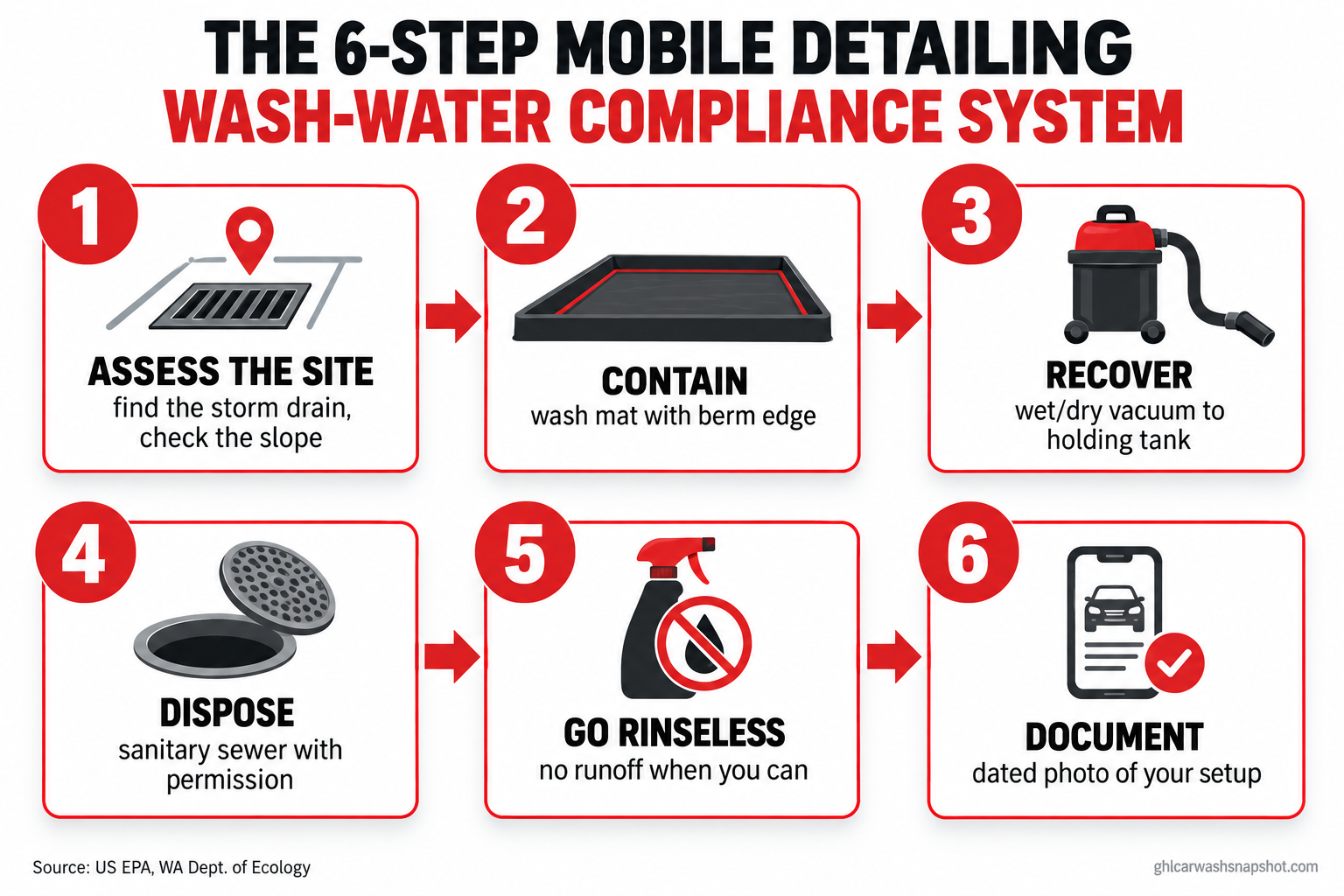
Here is the whole system, in the order you run it on site. Each step includes how it breaks, because that is where detailers get caught.
Step 1: Assess the site before you unpack
Before a drop of water hits the ground, find the nearest storm drain and figure out which way the pavement slopes. If gravity carries runoff toward that grate, you cannot wash there uncontained. Look for a landscaped area, a slop sink, or a sewer cleanout you could get permission to use.
How it breaks: you assume a flat lot is safe. Almost no lot is, and water finds the drain you did not see behind the dumpster. Walk it first.
Step 2: Contain the water
Containment is a wash mat or a set of berms that traps runoff under and around the vehicle so it never sheets across the pavement. A collapsible mat with a berm edge is the standard tool, and for a solo operator it is the single most important purchase you will make.
How it breaks: an undersized mat, or one you skip on a “quick” job. Regulators do not grade on effort. A partial detail with runoff escaping the mat is the same violation as no mat at all.
Step 3: Recover the water
Once it is contained, pull it off the mat with a wet/dry vacuum or a vacuum-berm setup into a holding tank. Now the water is in your control, not on the ground.
How it breaks: you let the mat “dry out” instead of vacuuming, and the next breeze or the client’s sprinklers push it to the drain overnight. Recover the water the same visit, every visit.
Step 4: Dispose of it legally
Take the recovered water to a sanitary sewer connection you have permission to use: a mop sink at a shop you partner with, your own home’s sewer cleanout (check local rules), or an approved disposal point. Some jurisdictions allow discharge to a landscaped or dirt area where it can soak in, but only where local rules specifically permit it (WA Dept. of Ecology).
How it breaks: you dump the tank down a random parking-lot drain that turns out to be storm, not sanitary. When in doubt, it is storm. Get the disposal point confirmed in writing.
Step 5: Go rinseless or waterless when you can
The cleanest way to pass a stormwater rule is to produce no wastewater. Rinseless washing uses a couple of gallons in a bucket and is toweled off; waterless products are sprayed and wiped with no runoff at all. For maintenance details, interiors, and touch-ups, this sidesteps the discharge question and cuts water use by roughly 95% (Jimbo’s Detailing).
How it breaks: using rinseless on a filthy, gritty vehicle and marring the paint. Match the method to the car. Heavy mud still needs contained rinsing.
Step 6: Document everything
Keep a photo of your containment setup on each job, a note of where you disposed of the water, and any written permission from property owners.
How it breaks: the records live only in your memory. When code enforcement calls three weeks later, “I always use a mat” is not evidence. A dated photo is.
The state-by-state reality
There is no single federal permit you file as a mobile detailer. The Clean Water Act sets the floor, then states and cities fill in the details. Here is the shape of it across a few representative jurisdictions.
| Jurisdiction | What it keys on | The practical rule |
|---|---|---|
| Federal (Clean Water Act) | Discharge to “waters of the US” | No wash water to storm drains without an NPDES permit; penalties to $66,712/day (40 CFR 19.4) |
| California | Municipal stormwater (MS4) programs | Contain and recover; discharge to sanitary sewer with permission. County BMPs like San Diego’s are enforced with fines to $10,000/day (San Diego County) |
| Washington | State Dept. of Ecology washwater rules | Storm drain discharge needs treatment plus an Individual Wastewater Discharge permit; sewer with sewer-authority approval; closed-loop recycling preferred (WA Ecology) |
| Most other states | Local ordinance under an MS4 permit | Same core duties: keep it out of the storm drain, route to sanitary sewer, keep records |
The lesson is not to memorize four rulebooks. The underlying duty is identical everywhere: keep wash water out of the storm drain. Build one compliant system and you satisfy the rule almost anywhere you drive.
Run it for your actual operation
The framework is the same, but what it costs and how you run it changes with your size.
The solo operator, one van. You do not need a reclaim trailer. You need a good containment mat, a wet/dry vac, a 20 to 30 gallon holding tank, and one confirmed sanitary-sewer disposal point. Lean on rinseless for maintenance jobs to cut how often you deal with water at all. Total gear cost is a few hundred dollars, the cheapest insurance you will ever buy.
The small crew, two or three vans. Now consistency is the risk. One tech who skips the mat on a busy Saturday exposes the whole business under your name. Standardize the kit in every van, make the containment photo a required field before a job is closed, and keep a shared list of approved disposal points by neighborhood.
The multi-van or fixed-plus-mobile operation. Here you are on commercial and fleet sites that ask for proof. Consider a closed-loop reclaim system for high-volume days, keep a written stormwater BMP you can hand a property manager, and treat your disposal agreements as accounts you maintain, not paperwork you filed once.
Steal this copy
You need language for the moments where compliance meets the customer. Lift this straight into your booking form and your texts.
Your booking-form line (sets expectations before you arrive):
“Quick heads-up on where we work: we use a water-containment mat and recover all wash water, so we may ask about the nearest sink or sewer access when we arrive. For most maintenance details we use a rinseless method that uses almost no water. It keeps your property clean and keeps us compliant with local stormwater rules.”
Asking a property manager for sewer access (opens the account, not just the job):
“Before we service vehicles at your property, I want to confirm how you’d like us to handle wash water. We contain and recover everything on a mat, and we need a sanitary-sewer point (a mop sink or cleanout) to empty it, never a storm drain. If that works for your site, I can put it in writing so it’s on file for your stormwater records too.”
The reschedule text when a site has no legal disposal:
“Hi [name], I got to the site and there’s no way to handle wash water here without it reaching the storm drain, which I’m not able to do legally. Two options: I can do a full rinseless detail today (no runoff, looks great), or we reschedule to [location] where I’ve got proper disposal. Which do you prefer?”
That last one matters more than it looks. A detailer who reschedules for a real reason reads as a professional, not a flake. Washing anyway and hoping is the exact move that ends up on a neighbor’s phone.
Objections, answered
“Nobody has ever checked my setup.” Maybe not yet. Enforcement here is complaint-driven, so you are fine right up until one neighbor, property manager, or competitor files a report. You do not control when that happens. The cost of being ready is a mat and a vacuum. The cost of being caught is a fine plus the accounts that drop you.
“My soap is biodegradable, so it’s allowed.” It is not. Biodegradable means it breaks down eventually, not that it is safe to put in a creek today. Regulators judge the discharge, not the label. A phosphate-free, plant-based soap sent to a storm drain is still a violation.
“Containment gear is too expensive for a one-van operation.” A containment mat and a wet/dry vac cost less than a single mid-range polisher, and far less than one $500-to-$10,000 fine. For a solo detailer it is the highest-return few hundred dollars you can spend, and it unlocks the commercial and HOA work that requires it.
“I only rinse, I don’t really make wastewater.” Rinse water is wastewater the moment it touches a dirty car. It picks up the same soap, oil, and grit as a full wash. A “quick rinse” that runs to the gutter is exactly the discharge the rule targets.
“Waterless and rinseless can’t get a car properly clean.” For heavy mud and grime, correct, you still need contained rinsing. For the maintenance washes and interiors that make up most routes, rinseless matches a traditional wash and marrs less, because you lift grit with lubrication instead of blasting it around.
FAQ
Is it illegal to let car wash or detailing water go down a storm drain?
In almost every US city, yes. Storm drains flow untreated to local creeks, rivers, and bays, so wash water that reaches one is a pollutant discharge under the Clean Water Act. The compliant path is to contain and recover the water and dispose of it to the sanitary sewer with permission.
Do I need a permit to run a mobile detailing business?
You need standard business licensing, and for wash water you are governed by Clean Water Act stormwater rules enforced locally. Most mobile detailers do not hold an individual discharge permit; they stay compliant by containing water and routing it to the sanitary sewer, or by using rinseless and waterless methods. Some states, like Washington, require a specific permit if you ever discharge to a storm system. Call your local stormwater program to confirm.
How much can I be fined for illegal wash water discharge?
Local ordinances typically run from $500 to $10,000 per day per incident, with San Diego County at the $10,000 ceiling. Federal Clean Water Act civil penalties reach $66,712 per day per violation, per 40 CFR 19.4. The bigger practical cost is losing the commercial and HOA accounts that require proof of containment.
Is biodegradable soap allowed to go down the drain?
No. Stormwater rules judge where the water goes, not what is in it. Even phosphate-free, plant-based soap is a violation if it reaches a storm drain, because it still carries oil, grit, and detergent into untreated waterways. Biodegradable is better for the environment, but it does not make discharge legal.
What is the difference between a storm drain and a sanitary sewer?
A storm drain moves rain off streets and empties untreated into the nearest natural water, so wash water there is illegal. A sanitary sewer connects to a treatment plant, so wash water there is generally acceptable with the property owner or sewer authority's permission. Every compliant setup keeps water out of the storm drain and routes it to the sanitary sewer.
Can I just do waterless or rinseless washes to avoid all of this?
For most maintenance details, yes, and it is the simplest way to stay compliant because you produce almost no runoff. Rinseless uses two to four gallons total and waterless uses less than one, versus 40-plus for an uncontained hose wash. Heavy mud and grit still call for contained rinsing, so match the method to the car.
The bottom line
Back to that Saturday driveway. The detail was fine. The water was the problem, and it was a problem the whole time, whether or not a neighbor filmed it. Storm drains run to creeks, the Clean Water Act has said so for decades, and the fines start at $500 and climb from there.
The fix is not complicated and it is not expensive. Contain the water, vacuum it up, dispose of it to a real sewer with permission, lean on rinseless for the jobs that allow it, and keep a dated photo so you can prove you had a system. Do that and the complaint that ends other detailers’ routes never touches yours. Better still, the same setup that keeps you legal is what lets you say yes to the commercial lots, apartment complexes, and fleets that will not book anyone who cannot prove it.