

It is 7:40 on a Wednesday and your van is loaded. You are backing out of the driveway when the phone lights up. “Hey so sorry, something came up, can we do another time?” The 9am ceramic prep you blocked three hours for just evaporated, and the next slot you can offer is Saturday. That is a $400 hole you will now spend the morning trying to backfill instead of working.
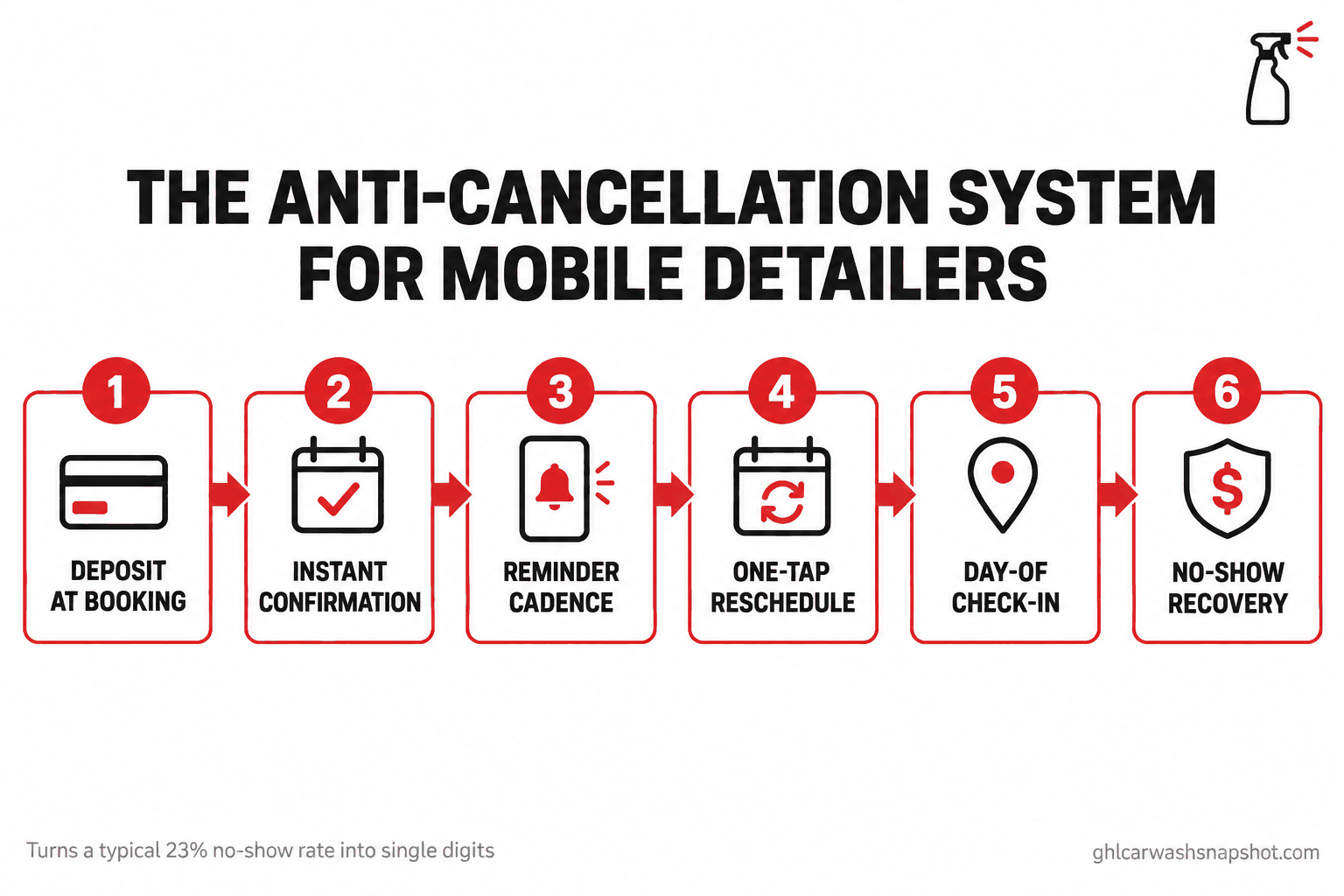
Mobile detailing customers cancel at the last minute for reasons that feel personal but are almost always structural: they forgot, work moved, weather turned, or cancelling was easier than showing up. You do not fix that with a sterner policy. You fix it with a system that takes a deposit at booking, confirms instantly, reminds on a set cadence, and makes rescheduling one tap instead of a phone call. Do that and you pull a typical 23% no-show rate down into the single digits. This is the full playbook, with the message copy you can steal and how each step breaks.
Table of contents
- What cancellations actually cost you
- Why they really cancel
- The anti-cancellation system
- Stage 1: Take a deposit at booking
- Stage 2: Confirm instantly
- Stage 3: The reminder cadence
- Stage 4: Make rescheduling one tap
- Stage 5: The day-of check-in
- Stage 6: No-show recovery
- Three real scenarios
- Policy and consent
- Objections, answered
- FAQ
What cancellations actually cost you
“A few no-shows” sounds harmless until you price it. At a $180 average ticket and 20 jobs a week, a 20% no-show rate is 4 lost jobs a week. Backfill only half and you leave roughly $360 a week on the driveway, close to $18,000 a year, before the fuel you burned driving to empty houses.
That rate is not something you are doing wrong. It is the baseline for appointment businesses: a systematic review of 105 studies put the average no-show rate at about 23%, ranging from 13% to over 40% (Dantas et al., 2018). Detailing behaves like every appointment-based field service.
Sources: Dantas 2018, Lin 2016, Tebra 2026, MIT/InsideSales.
The mobile and solo end of the roughly $18.7 billion US car wash and detailing market (IBISWorld) is its most software-underserved slice: most tools assume a front desk, and you have a van and wet hands. That gap is where cancellations slip through.
Why they really cancel
Most detailers assume the customer is flaky or cheap. The data says otherwise. A 2026 survey asked providers why people no-show and they blamed forgetting (81%); when it asked customers, the real answers were work conflicts (31%), weather (30%), personal emergencies (27%), and simply not feeling like it that day (Tebra, 2026).
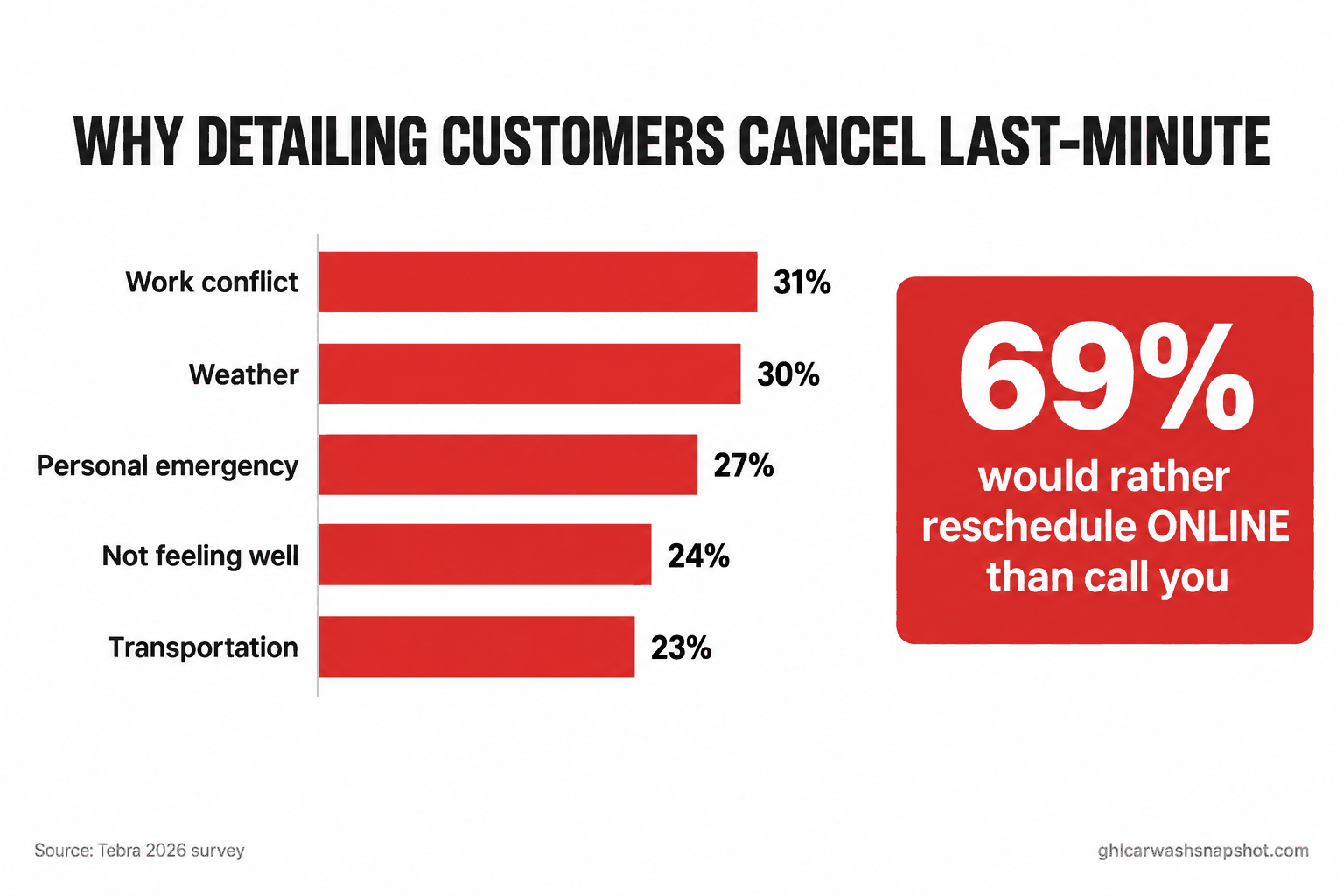
Almost none of that is about you or your price. It is life colliding with a soft commitment, and the biggest hidden factor is friction: 69% would rather reschedule online than pick up the phone. When the only move option is calling you, “cancel” wins by default. They are not rejecting you, they are avoiding the phone.
So you are not fighting bad customers. You are fighting a booking with no weight, no reminder, and no easy exit ramp. Every stage below adds one.
The anti-cancellation system
Six stages, start to finish, each closing a specific leak: a deposit at booking puts skin in the game, an instant confirmation locks the slot while they are keen, a reminder cadence beats forgetting, a one-tap reschedule turns a cancel into a move, a day-of check-in catches the last wobble, and no-show recovery rebooks the ones who still slip. A tool that fires the texts and holds the deposit automatically is the difference between doing this and meaning to.
Stage 1: Take a deposit at booking
A booking with no money attached is a wish. The highest-return change a mobile detailer can make is to collect a deposit at booking, not on arrival. It filters out the tire-kickers and gives the serious customer a reason to move the appointment instead of ditching it, because their money is riding on it. Platforms that require a deposit report no-show rates falling into the single digits. That is platform-reported, not a lab study, but sunk cost is a reliable mechanism: money down keeps the appointment top of mind.
How to set it up. Charge 20% to 30% of the job, applied to the final bill: $40 to $50 on a $180 interior-and-exterior, $150 to $200 on an $800 ceramic booking. Take it through your booking link with a card on file.
The copy that makes it land, not sting:
To lock in your Saturday 9am slot I take a $45 deposit that comes right off your total. It just holds the time so I am not driving out to an empty driveway. Card link here: [link]. See you Saturday!
How it breaks. Below 20% the deposit stops changing behavior; above 50% it scares people off. The other failure is a murky refund rule, so decide up front and say it in writing at booking: refundable if they reschedule with 24 hours notice, forfeit on a true no-show.
Stage 2: Confirm instantly
The window between “I think I want to book” and “it is on the calendar” is where good jobs die. A customer who messages at 8pm and hears nothing until you finish tomorrow’s last detail has already messaged two other detailers. A business is 100x more likely to reach a lead responding in 5 minutes instead of 30 (MIT/InsideSales), and Harvard Business Review’s audit of 2,241 firms found the average first response took 42 hours, with 23% never responding at all (HBR, 2011).
You cannot beat 42 hours by hand mid-detail. So the second the deposit clears, an automated confirmation texts the date, time, address, and price. That receipt anchors it: a real thing on a real day, not a vague plan.
The instant confirmation text:
You are booked! Saturday, Sept 27, 9:00am at 214 Oak St. Full interior + exterior, $180 ($45 deposit paid, $135 on the day). I text a reminder before I head out. Need to move it? One tap here: [reschedule link]. Reply STOP to opt out.
How it breaks. A confirmation with no reschedule link teaches the customer to call you, and 69% will not, so always include the self-serve link. And a confirmation you send by hand arrives late: if it is not automatic, it is not instant, and instant is the point.
Stage 3: The reminder cadence
Forgetting is the biggest driver of no-shows and the easiest to fix. In a randomized controlled trial, adding a text reminder cut the no-show rate from 38.1% to 23.5% (Lin et al., 2016), the cheapest revenue you will ever recover.
One reminder helps; a short cadence helps more, without becoming spam:
| When | Channel | Job of the message |
|---|---|---|
| At booking | Text | Instant confirmation with the reschedule link |
| 72 hours before | Text | Early heads-up while there is still time to move it |
| 24 hours before | Text | The main reminder, confirm address and access |
| Morning of | Text | “On my way” window and a running-late fallback |
The 24-hour reminder:
Reminder: I am detailing your vehicle tomorrow (Sat) at 9am, 214 Oak St. Please have it accessible and clear of personal items. Need to move it? Tap here: [reschedule link]. Otherwise, see you then!
How it breaks. Too many reminders train people to ignore them, so cap it at three plus the confirmation. Reminders with no reschedule link turn “I can’t make 9” into a silent no-show instead of a moved slot. And with no access ask, you arrive to a packed car or no spigot, and the job runs long or dies on the driveway.
Stage 4: Make rescheduling one tap
This is the stage most detailers skip, and the one that turns the numbers around. When a kid gets sick or a meeting lands on your slot, the customer has two options. Option A is call, feel bad, and negotiate a new time. Option B is just not show up. If Option A is a phone call, most take Option B, which is why 69% would rather reschedule online than call (Tebra, 2026).
So make Option A the easy one. Every confirmation and reminder carries a self-serve reschedule link: one tap, pick a new slot, deposit riding along. You have converted the thing you feared into a job you keep, and the customer feels handled, not guilty.
The proactive reschedule offer, sent when they go quiet on the morning-of text:
No stress if today got away from you. Want to grab a better time? Your deposit moves with you, no charge to reschedule. Pick a new slot here: [link]. I have openings Thu afternoon and Sat morning.
How it breaks. A reschedule link with no real availability, or one that dumps them into a “call to confirm” step, defeats the purpose: it has to book a real slot on the spot. And with no boundary, the easy path becomes a revolving door, so hold the line: reschedule free with 24 hours notice, deposit forfeits on a same-day no-show.
Stage 5: The day-of check-in
The morning of the job is the last wobble. A short “on my way” text reconfirms without asking a question that invites a cancel, sets the arrival window, and gives a running-late customer a graceful way to flag it before you are parked outside an empty house. Send a “20 minutes out” text once you leave the previous job. Detailing often needs the customer to move a car or unlock a gate, so telling them exactly when you arrive removes the excuse.
The 20-minutes-out text:
On my way, about 20 minutes out. Could you pull the vehicle into the driveway and make sure I can reach a water spigot and an outlet? Text me if anything changed. See you shortly!
How it breaks. Arriving with no warning, then finding the car gone or blocked in a garage, is a wasted trip that counts like a no-show. And treating the check-in as a yes-or-no question (“are we still on?”) hands a wavering customer the opening to bail. State that you are coming, do not ask permission.
Stage 6: No-show recovery
Some will still slip. The system is not about hitting zero, but shrinking the number and rebooking the ones who fall through. When a customer misses the window, do not write them off: send a fast, human, no-judgment rebook text while the deposit and goodwill still exist.
The no-show recovery text (send within the hour):
Hey, I was at 214 Oak St at 9 but couldn’t reach you. No worries, things come up. Want to grab a new time this week? Your deposit still applies. Next openings: Thu 2pm, Sat 9am: [link].
If they rebook, you saved the job. If not, a single follow-up two days later closes it out, and your deposit rule means you were not working for free. Detailing is a repeat and referral business, so even a one-time no-show is worth a warm door, not a burned one.
How it breaks. Waiting a day lets the moment cool and the guilt curdle into avoidance. Send it within the hour, while they still want to make it right, and never send it angry: one sharp text can cost you the customer, their household, and the review.
Three real scenarios
Same system, different focus by size.
The weekend solo, one van, side income. You run 6 to 10 jobs a week and cannot afford to lose two. Your highest-return move is the deposit plus the 24-hour reminder, nothing fancier. Those two beat a complicated flow you will not keep up by hand.
The full-time solo, booked most days. Every no-show is a slot you could have sold to your waitlist, so the reschedule link and recovery matter as much as the deposit. Automate the whole cadence, because doing it by hand between jobs is exactly when it slips. This is who benefits most from a booking and reminder system that runs the confirmations, reminders, and rebooks for you.
The small mobile team, two or three vans. A missed job is a crew’s idle hour. You need the full system plus dispatch discipline so two vans never get double-booked, and a fast answering layer so a new lead never routes to voicemail. Many operators here hand it to a done-for-you setup rather than build it between jobs.
Policy and consent
Two boring things save real headaches. Write your cancellation and deposit policy in plain words and show it at booking, not after a dispute: the deposit amount, that it applies to the final bill, free rescheduling with 24 hours notice, and forfeit on a same-day no-show. A clear policy is what lets you stay relaxed and human in every message above.
And the texts. Every message here needs the customer’s consent and an easy opt-out. Collect explicit opt-in at booking, include “Reply STOP to opt out,” and keep them to service updates about their actual appointment. The FCC’s rules on unwanted calls and texts are the backdrop, and appointment texts a customer asked for are the kind you may send once that consent is on file.
Objections, answered
“Won’t asking for a deposit scare customers off?” The ones it scares off are mostly the ones who were going to cancel anyway. Serious customers expect it, especially on higher-ticket work like ceramic coating. Frame it as holding the time, not a trust test, and apply it to the final bill.
“Won’t all these texts annoy people?” Not when they are useful and spaced out. A confirmation, a heads-up, a reminder, and an “on my way” text are messages a customer wants, because detailing needs them to move a car and provide water and power. Annoying is six generic blasts. Keep it tight and always include the opt-out.
“I already use a scheduling app. Isn’t that enough?” A scheduler holds the calendar, but most are passive: they wait for the customer and do not chase a wobble or rebook a no-show. That is the gap the best mobile detailing tools leave open. Add the deposit, reminder, and recovery layer on top, or run it all from one system.
“I’m a one-person operation. Isn’t automating this overkill?” The solo detailer loses the most to cancellations, because there is nobody else to send the reminder or answer the phone while you work. Automating the deposit, reminders, and recovery is the closest thing you have to a front desk, at a fraction of the cost.
The bottom line
Your customers are not flaky. Your bookings are weightless. A verbal yes days in advance, with no deposit, no reminder, and no easy way to move it, is a promise built to break. The six stages change the physics: weight from a deposit, a reminder cadence against forgetting, a one-tap reschedule that turns cancels into moves, and fast recovery for the rest.
You do not have to build it by hand between details. The GHL Car Wash Snapshot for mobile detailers installs the booking link, card-on-file deposits, the reminder cadence, easy reschedule, and no-show recovery as one system, wired to SMS automation and appointment automation so it all fires while your hands are busy. Set it up once, and the Wednesday-morning cancel text stops being a $400 hole and becomes a job you move to Saturday.
FAQ
How do I stop mobile detailing customers from cancelling last minute?
Take a deposit at booking, confirm instantly, run a short reminder cadence (72 hours, 24 hours, morning-of), and make rescheduling a one-tap link instead of a phone call. Deposits give the booking weight, reminders beat forgetting, and easy rescheduling turns cancels into moved jobs.
What is a normal no-show rate for appointment businesses?
About 23% on average across 105 studies (Dantas et al., 2018), ranging from roughly 13% to over 40%. Detailing behaves like other appointment-based field services, and a deposit plus reminders can pull that into the single digits.
How much deposit should a mobile detailer charge?
Usually 20% to 30% of the job, applied to the final bill: about $40 to $50 on a $180 detail, $150 to $200 on an $800 ceramic booking. Below 20% it stops changing behavior; above 50% it costs you bookings. Take it via a card on file.
Do text reminders actually reduce no-shows?
Yes. A randomized controlled trial cut the no-show rate from 38.1% to 23.5% just by adding a text reminder (Lin et al., 2016). A cadence of confirmation plus 72-hour, 24-hour, and morning-of texts works even better, as long as each includes a way to reschedule.
Is it legal to text customers appointment reminders?
Yes, with their consent. Collect explicit opt-in at booking, keep messages to updates about their actual appointment, and include a clear opt-out like 'Reply STOP.' Appointment texts a customer asked for are the kind you may send under the FCC's rules once consent is on file.
Can I keep my current scheduling app and still fix cancellations?
Yes. Most apps hold the calendar but do not take a deposit, chase a wobbling booking, or rebook a no-show. Add a deposit, reminder, and recovery layer on top of the scheduler you like, or run it all from one system.
Related posts
- Best Software for Mobile Detailing in 2026: Urable vs Mobile Tech RX vs Jobber vs Housecall Pro
- Car Wash Online Booking: How to Take Detail & Membership Appointments 24/7
- Car Wash SMS Marketing: The Text-Message Playbook That Fills Bays
- AI Receptionist for Car Washes: Stop Losing Members to Missed Calls
- Mobile Detailing Wastewater Rules: The Compliance Checklist Nobody Gave You