

The renewal quote lands on a Tuesday. Your DRB agreement is up again, and the line that stops you is not the software number. It is the merchant services bundled underneath it, quietly one of your biggest fixed costs. You run two tunnels. You are not a 40-site chain. And you are paying for a platform built for one.
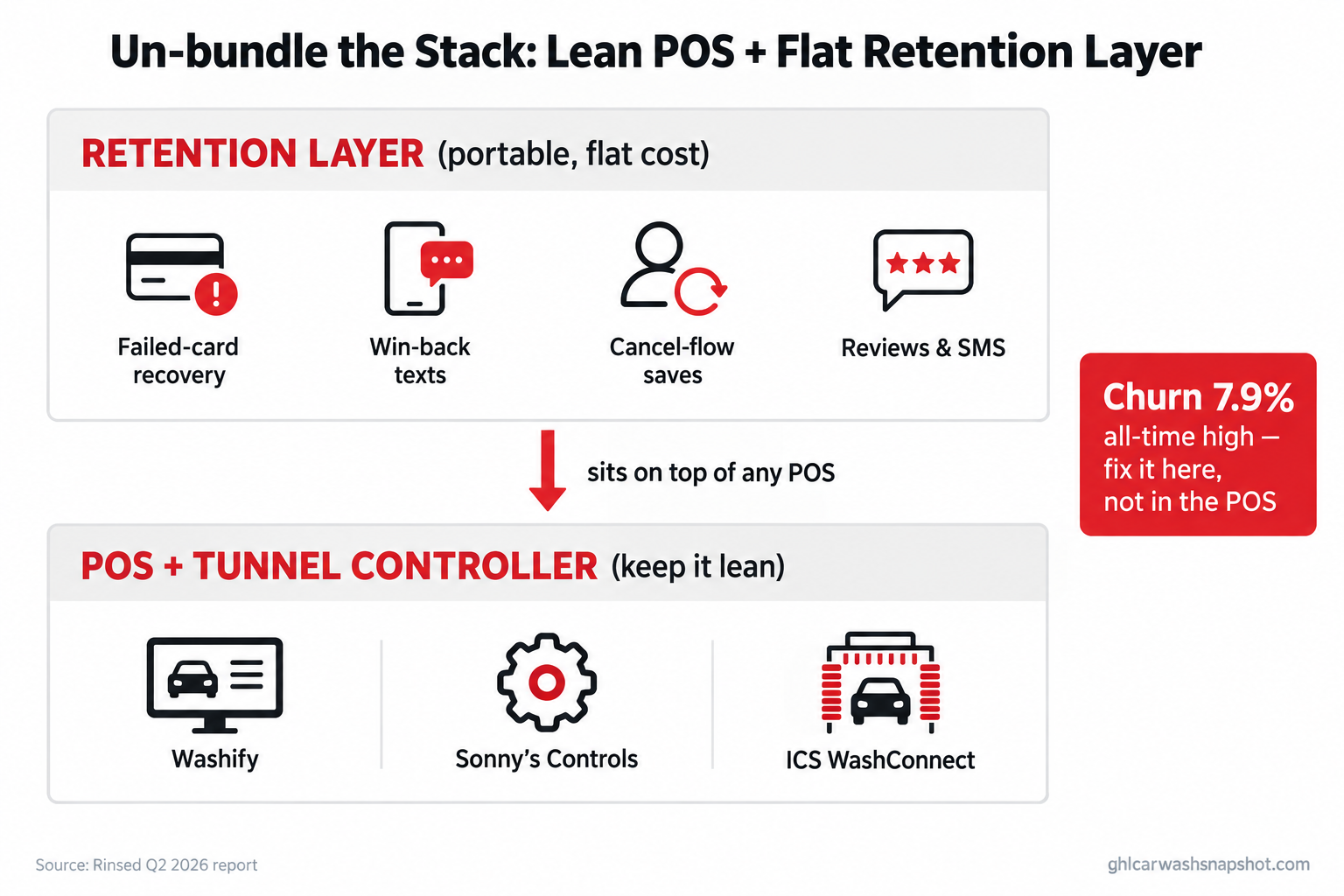
Here is the honest answer up front. If you run one to three tunnels, DRB’s Patheon is probably more platform than you need, priced and contracted for operators much larger than you. The real alternatives split into two jobs DRB bundles together: the POS and tunnel controller (Washify, Sonny’s CarWash Controls, ICS WashConnect) and the membership and retention layer (Rinsed, or a GoHighLevel-based system). You do not have to solve both with the same expensive vendor, and for a small tunnel, un-bundling them is where the savings come from. This guide walks the alternatives one by one, with the reported numbers, the migration traps, and how each breaks.
Table of contents
- What DRB and Patheon actually are
- Why small tunnels outgrow DRB in the wrong direction
- The eight things to judge any DRB alternative on
- The alternatives, one by one
- The reported numbers, side by side
- Three real scenarios: one tunnel, three-site chain, tunnel plus detail
- The migration reality nobody quotes
- Steal these: the switch audit and the demo-call script
- Objections, answered
- FAQ
What DRB and Patheon actually are
DRB is the biggest name in tunnel and express car wash technology. It supports three point-of-sale products: Patheon (the next-gen cloud POS), the older SiteWatch, and Washify (the lower-cost tier it acquired in 2021) (DRB POS solutions). On top of the POS sits the tunnel controller, XPT pay stations, FastPass RFID that reads a member in about two seconds (DRB vehicle identification), license plate recognition, and unlimited membership billing.
For a multi-site chain running thousands of cars a day, that earns its keep. Patheon is aimed at high-throughput tunnels and multi-site operators who need advanced control and cross-location analytics (Patheon overview). The problem is the operator this article is for: the one, two, or three-tunnel owner who bought DRB because it was the name everyone knew, and now pays enterprise money for features that never get switched on.
Why small tunnels outgrow DRB in the wrong direction
Most software you outgrow by getting too big for it. DRB is the opposite: small operators outgrow their patience with it because they never get big enough to use what they pay for. Three things drive that.
The pricing is custom and it climbs. DRB does not publish a rate card. Every number is quoted on a call, and price increases are routine (Patheon listing, SourceForge). One widely cited alternatives roundup reports operators paying around $4,500 a year in software plus close to a thousand a month in required merchant services, with a bump of up to 5% in a single year (DRB alternatives roundup, devaims). Treat that as reported, not official, but the pattern of pricing that only moves up is real.
The merchant processing is bundled. When your card processing is tied to your POS vendor, you cannot shop it, and the blended rate becomes part of a platform cost you cannot negotiate down without leaving.
It is complex enough to need a lifeline. Operators report keeping DRB tech support on speed dial, not for outages, but to make routine changes to a system too intricate to self-serve (Car Wash Forum). A GM filing a support ticket to change a promo price is friction you pay for.
None of this means DRB is bad software. It means it is the wrong size. The fix is not always “rip out the POS.” Often it is “stop asking the POS to be your marketing and retention system too.”
The eight things to judge any DRB alternative on
Before you look at a single logo, write down what matters.
- Pricing model. Per-site, per-unit, revenue share, or one-time. The model matters more than the sticker.
- Fit for one to three sites. Built for you, or scaled down from an enterprise tool?
- Contract length and lock-in. Month-to-month, annual, or multi-year.
- Merchant processing. Bundled and captive, or bring-your-own so you can shop rates.
- Hardware coupling. Does switching force new pay stations, RFID readers, or LPR cameras?
- Membership billing. Native, or leaning on a separate layer?
- Retention and churn tools. Dunning, win-back, cancel-flow. Where your money leaks.
- Data ownership. Can you get your member list and card vault out cleanly if you leave?
Half of these are about the retention layer, not the POS. That is the whole point of un-bundling.
The alternatives, one by one
Washify (DRB’s own cheaper tier)
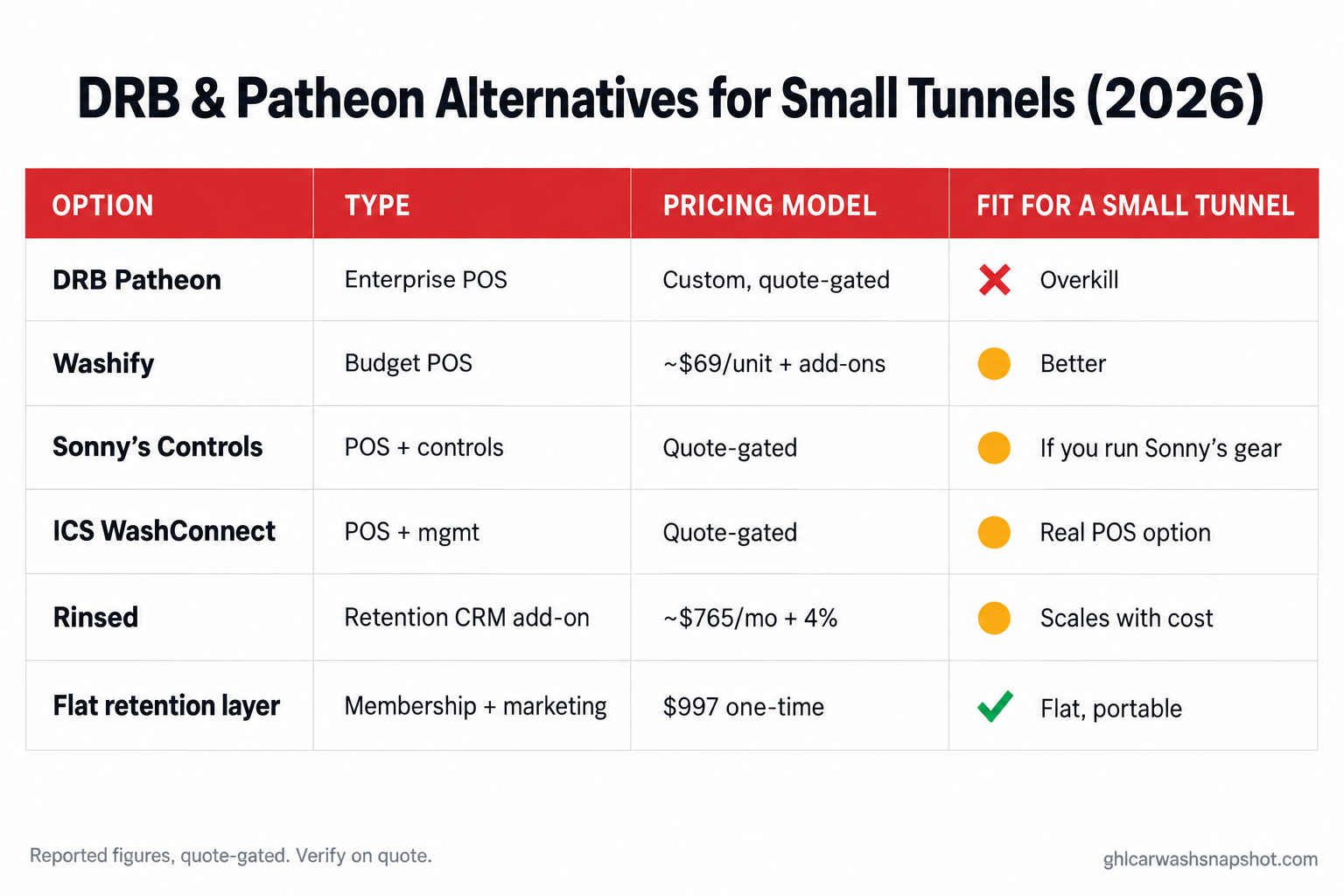
The most common “DRB but lighter” move is Washify, which DRB now owns: a pay-station and POS line aimed at lower-cost installs (Washify by DRB). Operator reports on Car Wash Forum put the base license near $69 per unit per month, add-ons like gas-station code integration around $49 per unit, and the all-in at roughly $119 to $200+ per unit once modules and processing stack up (Car Wash Forum). It fits an operator who wants to stay inside DRB but shed the Patheon weight. It breaks like any per-unit model: it climbs every time you add a lane, and the processing and data questions do not fully go away.
Sonny’s CarWash Controls
Sonny’s sells controls and POS bundled with the tunnel equipment many operators already bought from them: mPOS, a cloud controller, and PayStation for express exterior (Sonny’s Controls). Pricing is quote-gated. It fits if you already run Sonny’s gear and want support under one roof. It breaks like DRB: one large vendor owns the stack, and you still solve retention separately.
ICS WashConnect
ICS (now under OPW) sells WashConnect, a POS and management system for single and multi-site washes with EMV terminals and LPR (ICS POS management). A genuine DRB competitor at the POS layer. It fits operators who want a full POS alternative without going to Sonny’s. It breaks on the same two points: pricing is a phone call, and the marketing tooling is thin next to a dedicated retention layer.
Rinsed (the retention layer, not a POS)
This is the one small operators misunderstand. Rinsed is not a POS. It is a CRM and retention layer that bolts onto whatever POS you run, DRB included, for failed-card recovery, win-back, online membership sales, and retail-to-member conversion. Reported pricing is around $765 per month per location plus a $599 setup and a 4% commission on memberships sold through Rinsed (Rinsed pricing). It fits a chain that wants best-in-class churn analytics and can absorb a commission that scales with success. It breaks for a small tunnel, where the per-location fee plus 4% can cost more than the POS. See the full head-to-head in Rinsed vs GoHighLevel and what membership software costs.
The flat retention layer (GoHighLevel-based)
The last option keeps your POS where it is and puts a flat-cost engine on top for everything DRB overcharges you to do at the membership layer: signup funnels, dunning, win-back texts, review harvesting, and two-way SMS. A GoHighLevel-based system like the monthly membership wash setup sits here, decoupled from member count.
The enterprise bundle vs the un-bundled small-tunnel stack
One vendor (DRB/Patheon): POS + tunnel controller + membership billing + captive processing + marketing, on a custom multi-year contract that only moves up. Every lever owned by one company.
Un-bundled: a lean POS you can shop (Washify, Sonny's, ICS) + a flat, portable retention layer for churn, dunning and win-back. Costs you can negotiate piece by piece.
The reported numbers, side by side
Here is the reported 2026 picture. Every POS vendor here gates pricing behind a demo, so treat the figures as reported ranges, not rate cards, and confirm on the day you buy.
| Option | What it is | Pricing model | Reported cost | Fit for a small tunnel |
|---|---|---|---|---|
| DRB Patheon | Enterprise POS + controller | Custom, quote-gated | Not published; routine increases | Overkill for 1-3 sites |
| Washify (DRB) | Budget POS tier | Per unit | ~$69/unit + add-ons, ~$119-200+ all-in | Better, still per-unit creep |
| Sonny’s Controls | POS + controls | Quote-gated | Not published | Good if you run Sonny’s gear |
| ICS WashConnect | POS + management | Quote-gated | Not published | Real POS alternative |
| Rinsed | Retention CRM (add-on) | Per location + commission | ~$765/mo + $599 setup + 4% | Powerful, scales with cost |
| GHL retention layer | Membership + marketing | One-time + flat sub | $997 one-time + GHL plan | Flat, member-count-independent |
Sources: DRB Patheon, Washify reports, ICS, Rinsed pricing, GoHighLevel pricing. Numbers vary by site count and modules.
Three real scenarios
The right answer changes with your size. Here is the same framework run three ways.
Scenario 1: the single tunnel owner
You run one express tunnel, maybe 800 members. Patheon is wasted money. The move is a lean POS you can live with (Washify to stay in the DRB family, ICS or Sonny’s if you are switching gear anyway) plus a flat retention layer for dunning and win-back. Your biggest leak is not the POS. It is the members quietly canceling, with voluntary churn at 4.9% industry-wide (carwash.com). Fix that with a cheap, portable layer.
Scenario 2: the three-site chain
Now per-location fees bite. Rinsed’s fee plus 4% commission gets expensive fast at three sites with growing clubs, while a flat retention layer that ignores member count wins clearly on cost. Keep the POS decision per-site if your hardware is mixed, but standardize the retention layer across all three for consistent reporting. See when multi-site operators outgrow off-the-shelf tools.
Scenario 3: tunnel plus a detail bay
Add interior detail or ceramic packages and you have appointment-based revenue a tunnel POS handles poorly. DRB was never built to book and remind a $300 detail. A separate scheduling and follow-up layer covers the detail side while the POS runs the tunnel. Forcing both into one vendor is how operators overpay.
The migration reality nobody quotes
If you do leave DRB at the POS level, go in with eyes open. Tunnel POS is wired into your site, which makes switching harder than swapping a SaaS login.
Hardware coupling. Pay stations, RFID readers, and LPR cameras are often tied to the POS vendor. DRB’s XPT pay stations and FastPass RFID are DRB gear (DRB hardware). Switching POS can mean replacing that equipment, a capital cost, not a subscription line. Get written hardware compatibility from any new vendor before you sign.
Contract and data lock-in. Operators report feeling like they are “renting their own data” on multi-year terms (DRB alternatives roundup). Get your member list, billing history, and card vault export in writing first. Card vault migration has to run through your processor, and if the tokens cannot move, every member re-enters a card, which is a churn event waiting to happen.
The processing question. If your processing is bundled with DRB, leaving the POS means moving processing too, a win because you get to shop rates, but a project, not a toggle.
Steal these: the switch audit and the demo-call script
The 10-minute switch audit
Run this before you talk to any vendor. Write the answers down.
- What am I paying DRB per month, all in, including merchant services?
- Which Patheon features do I actually use? Cross out the ones I do not.
- What is my monthly voluntary churn costing me in lost dues?
- Is my card processing bundled or separate, and when does my contract renew?
- Can I export my member list and card vault, and have I asked in writing?
If most of your Patheon features are crossed out and your real pain is churn, you have a retention problem wearing a POS costume.
The vendor demo-call script
Read these verbatim on every demo to surface the buried costs before you sign.
- “Send me your all-in monthly cost for my exact site count, in writing, before this call ends.”
- “Is credit card processing bundled and required, or can I bring my own processor?”
- “What is the contract length and the early-termination fee?”
- “If I leave, can I export my member list, billing history, and card vault, and who owns that data?”
- “Does switching require me to replace my pay stations, RFID readers, or LPR cameras, and is there any commission or revenue share on top of the monthly price?”
The two retention texts that save more members than any POS
The churn happens in the messages you never send. Steal these.
Failed-card recovery (send within an hour of a decline):
Hi {first name}, it’s {wash name}. Heads up, the card on your unlimited plan didn’t go through this month. No interruption yet, just tap here to update it in 20 seconds so your plan keeps rolling: {link}. Reply STOP to opt out.
Cancel-flow save (trigger the moment a member starts a cancellation):
Hey {first name}, saw you’re thinking about pausing. Before you go, want a free month while you decide? Reply YES and it’s done. Or if life just got busy, we can pause instead of cancel so you keep your rate. Which one?
Fired automatically off the right triggers, those two messages recover members a per-unit POS fee will never win back, and they run just as well on a DRB tunnel as any other. For the full playbook, read how silent card churn drains a wash club and how to launch an unlimited club.
Objections, answered
“Switching POS sounds like a nightmare. Isn’t it easier to stay?” Often, yes, which is exactly why you should consider not touching the POS at all. Leave the tunnel controller where it is and move only the membership layer. Most of the cost relief, none of the hardware risk.
“I already pay for DRB. Won’t a second tool just add cost?” Only if it overlaps. A flat retention layer replaces the marketing, dunning, and win-back functions you are either overpaying DRB for or not using. The test: if it recovers more dues per month than it costs, it pays for itself. At 4.9% voluntary churn, recovering a fraction of cancelers covers a flat fee several times over.
“Do I need to be technical to run something outside DRB?” No. A GoHighLevel-based system ships pre-built. If you can send a text, you can run it, no support ticket needed to change a promo price.
“Isn’t Rinsed the industry standard?” It is genuinely strong, and for a large chain that lives on churn analytics it is a fair pick. But its per-location fee plus 4% commission is priced for scale. For one to three tunnels, a flat-cost layer usually does the core jobs for less. Compare them in Rinsed vs GoHighLevel, and if you are still choosing a core system, our car wash CRM buyer’s guide lists the nine things it must do.
The strategic read is simple. Members are the revenue, retail is shrinking, and members leave through the retention layer, not the tunnel. Un-bundle, keep the POS lean, and put a flat, portable tool on the part that decides whether your MRR grows.
FAQ
Is DRB Patheon worth it for a small car wash?
For a one to three-site operator, usually not. Patheon is built for high-throughput tunnels and multi-site chains, and its custom pricing plus bundled merchant services is sized for operators much larger than you. Smaller tunnels often pay for capabilities they never switch on.
Do I have to replace my hardware if I leave DRB?
Possibly. Pay stations, RFID readers, and LPR cameras are often tied to the POS vendor, so switching can mean replacing that gear. Get written hardware compatibility from any new POS vendor before you sign. This is the biggest reason many operators keep the POS and change only the retention layer.
Is Rinsed a replacement for DRB?
No. Rinsed is a CRM and retention layer that bolts onto your existing POS, DRB included, to recover failed cards and win back members. It does not run your tunnel. Reported pricing is about $765 per month per location plus a $599 setup and a 4% commission on memberships it sells.
How do I keep my member data if I switch systems?
Ask in writing before you sign. Request an export of your member list, billing history, and card vault. The vault is the tricky part, since token migration has to be handled by your processor. If the tokens cannot move, members must re-enter cards, which causes churn.
Why is membership churn such a big deal in 2026?
It is at an all-time high. Rinsed's Q2 2026 report put total monthly churn at 7.9%, with voluntary cancellations at 4.9%, up 9.2% year over year. With retail falling and membership revenue up 10.4%, protecting your member base is where the money is, and that happens in the retention layer.
Nico Ferraro ran the membership program for a three-location express tunnel operation before moving into GoHighLevel consulting. He thinks in conversion rates and churn cohorts, and he writes the playbooks he wishes he’d had on day one.