

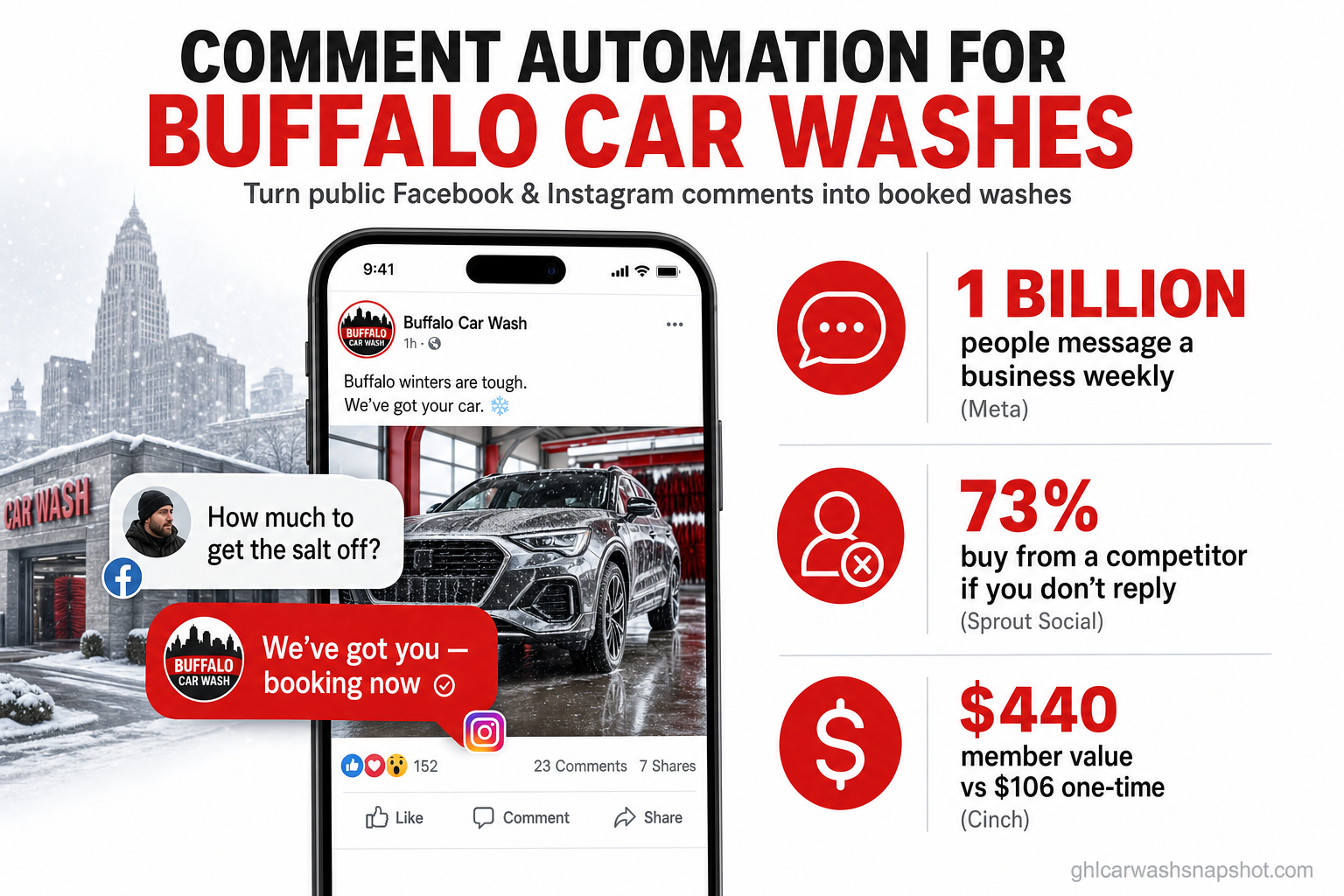
Comment automation is software that watches every comment on your car wash’s Facebook and Instagram posts and ads, replies to each one in your brand voice within seconds, and quietly moves the real buyers into a private message that qualifies them and books the wash — 24/7, without anyone at the wash touching a phone. For a Buffalo operator, that speed is the whole game: a driver who comments “how much for a full detail after all this salt?” under your Reel is deciding right now, and if your page sits silent for three hours while your crew is heads-down in the bays, they’ve already messaged the wash on the other side of Transit Road. Across social media, 73% of consumers say they’ll buy from a competitor when a brand doesn’t respond to them (Sprout Social 2025 Index). Every ignored comment is a wash that got booked somewhere else.
This is a plain-English explainer for the Buffalo wash and detailing operator who keeps seeing comments pile up unanswered — what comment automation actually is, how it turns a public comment into a recurring member, and why a snow-belt market makes the leak more expensive than most.
Table of contents
- What comment automation actually is
- Why comments are booking signals, not vanity metrics
- Why Buffalo makes this urgent
- How comment automation books a wash, step by step
- What a comment is actually worth
- Comment automation vs DM automation vs doing it by hand
- What comment automation can’t do
- FAQ
What comment automation actually is
Comment automation is an AI agent connected to your Facebook Page and Instagram account that does three jobs the instant someone comments on a post, a Reel, or an ad:
- It replies in public. A fast, on-brand reply under the comment — answering the question, dropping a price range, or pointing to the booking link. Public replies do double duty: they help the driver and signal to the algorithm that your post is worth pushing to more people.
- It moves the real buyer to a private message. When a comment is a genuine inquiry (“do you do ceramic?”, “how much for the unlimited club?”), the agent opens a direct message, so the back-and-forth — price, timing, vehicle — happens privately instead of spilling across your public feed.
- It qualifies and books. In the DM, the agent asks the two or three questions that matter (what service, what vehicle, when), then drops the driver straight onto your calendar or membership signup — no human in the loop until a real appointment exists.
That’s the difference between comment automation and just “posting more.” Posting gets you discovered. Comment automation captures the demand that discovery creates, in the seconds when a Buffalo driver is actually deciding. It is the close-the-loop layer that sits on top of everything else you do on social — and it pairs directly with the DM inbox automation that handles the messages drivers send you cold.
Why comments are booking signals, not vanity metrics
Most operators treat comments as applause — nice to get, nothing to act on. That’s the expensive mistake. A comment under a car wash post is almost never small talk; it’s a driver raising a hand. And the data on what happens when you leave that hand in the air is blunt.
Across social media, 73% of consumers say they’ll buy from a competitor when a brand doesn’t respond to them, and most expect a reply within 24 hours or sooner (Sprout Social 2025 Index). Social isn’t a billboard anymore; it’s a conversation channel people expect you to staff. The scale is hard to overstate: roughly 1 billion people message a business every week across Meta’s apps (Meta, via Adweek), and 35% of consumers now turn to social media first to find local businesses and things to do (Sprout Social 2025 Index). For a growing, phone-native city, your comment section is your storefront window.
But the window only sells if someone’s standing in it. Speed is the quiet deciding factor, and it has been measured for years: responding to a new lead within 5 minutes makes it 21× more likely to qualify than waiting 30 minutes, from the foundational MIT/InsideSales lead-response study of more than 15,000 leads (MIT / InsideSales). No human watching a phone between wash cycles can hit a 5-minute window every time. An automation hits it on every comment, at 2 p.m. on a busy Saturday and at 10 p.m. on a Sunday.
Why Buffalo makes this urgent
Every wash benefits from answering its comments. Buffalo operators have a few reasons to move now.
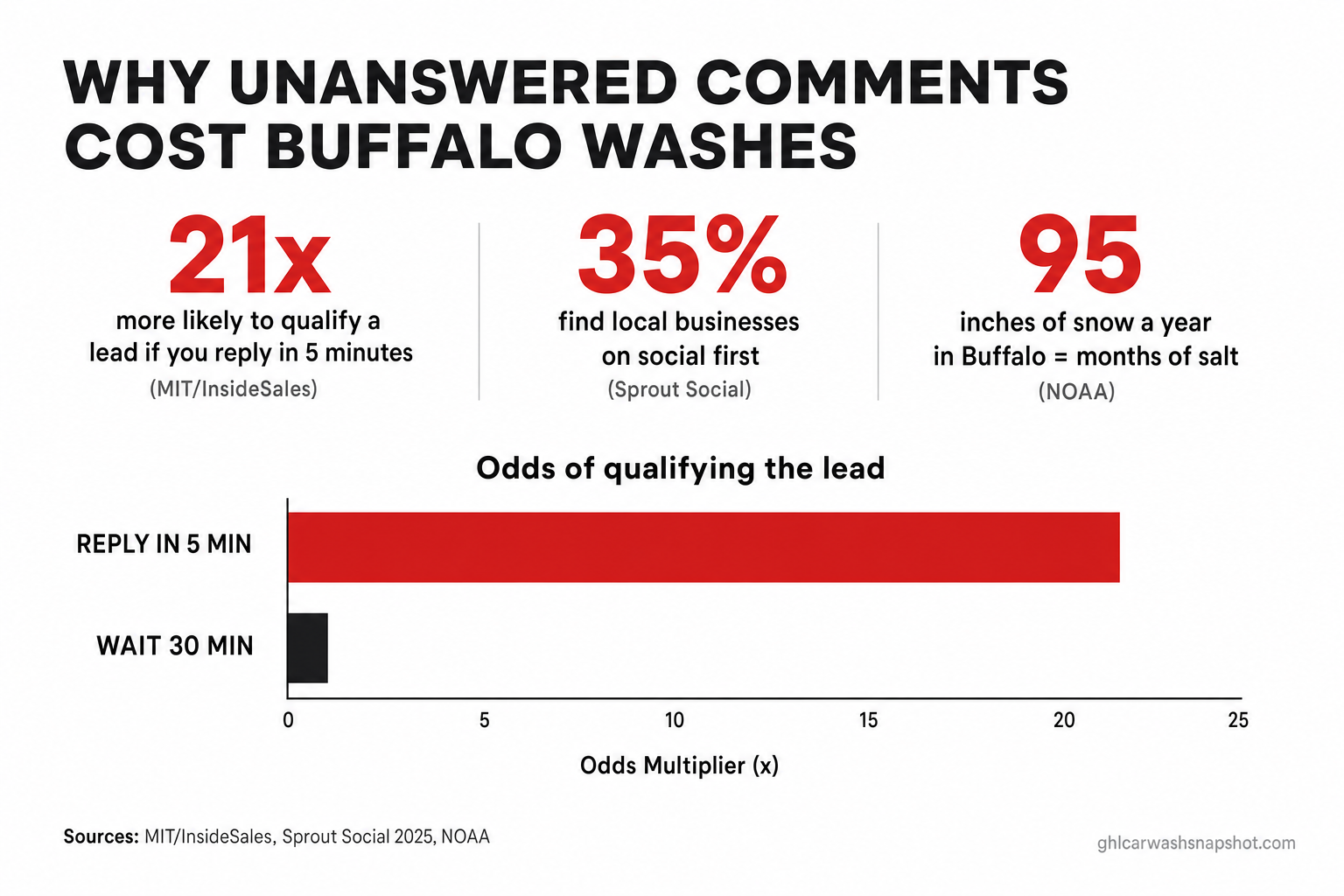
The weather manufactures demand — and questions. Buffalo averages roughly 95 inches of snow a year, more than three times the national average (NOAA / National Weather Service Buffalo). That means months of road salt, brine, and slush caking every vehicle in Erie County — and a steady stream of seasonal comments: “Are you open after the storm?”, “Do you get salt out of the undercarriage?”, “Is the unlimited worth it in winter?” Those are the exact comments that convert, and they spike on the days your team is busiest digging out and running the tunnel flat out.
The local market is big enough to matter. Erie County is home to roughly 950,600 people (U.S. Census / USAFacts), with about 276,000 in the city of Buffalo itself (U.S. Census QuickFacts). That’s a deep pool of salt-covered vehicles and a crowded field of washes competing for them — and social is increasingly where that competition plays out, since 76% of consumers say social content influenced a purchase in the last six months (Sprout Social 2025 Index).
The category is growing, so the feed is getting louder. The U.S. car wash services market is projected to climb from about $12.25 billion in 2025 to $21.26 billion by 2035 (Market Research Future) — estimates vary by firm, but every major one points up. Rising demand pulls in new tunnels and new ad spend, which means more posts, more boosted Reels, and more comments chasing the same drivers. In a noisier feed, the wash that answers first wins the booking.
Silence is the leak. Put the Buffalo picture together — hundreds of thousands of salt-covered cars, a metro that researches local businesses on social, and a winter that generates comments in bursts — and an unanswered comment section isn’t neutral. It’s a daily handoff of ready-to-book drivers to the competitor who replied.
How comment automation books a wash, step by step
Here’s the actual sequence, from a driver’s thumb to a booked wash. None of it requires you or your crew to be watching a screen.
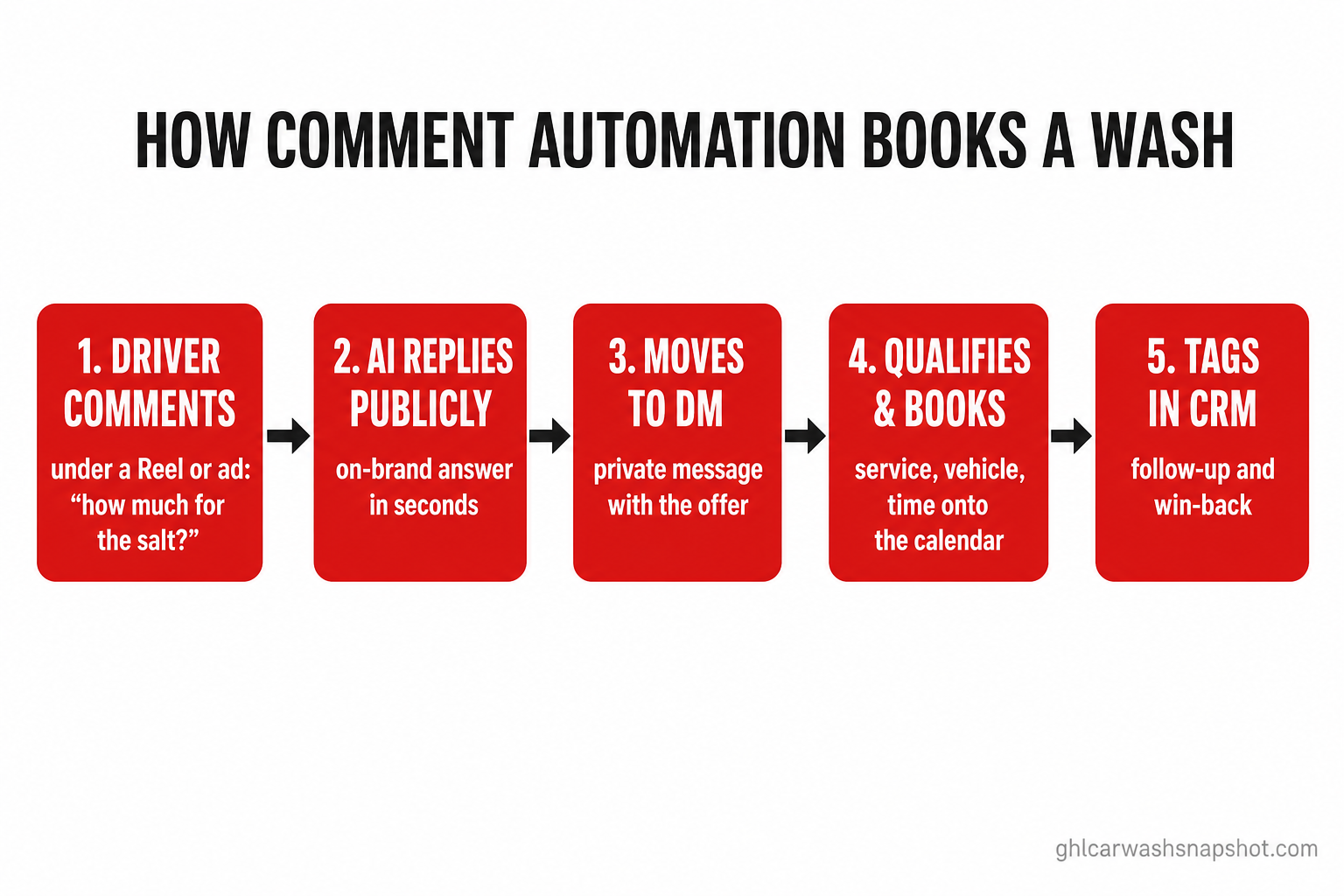
- A driver comments. Under your dirt-to-gleam Reel, your “we’re open after the storm” post, or a boosted ad: “How much to get the salt off a Tahoe?” This is the moment demand shows up.
- The agent replies in public — in seconds. A friendly, on-brand answer with a price range and a nudge to book. Fast public replies keep the thread helpful and signal to the algorithm that the post deserves more reach.
- It opens a private DM. For genuine inquiries, the agent moves the conversation into Messenger or Instagram Direct, where it can talk specifics — vehicle, service, timing — without cluttering your public feed.
- It qualifies and books. Two or three questions later, the driver is on your calendar for a detail, signed up for the unlimited club, or flagged as a fleet lead — routed straight into booking. For the mechanics of the booking side, see the car wash online booking playbook.
- It tags the lead and hands off. The contact lands in your CRM, tagged by service and source, so nurture, reminders, and win-back can take it from there. A driver who didn’t book today gets a follow-up instead of being forgotten.
What a comment is actually worth
The reason this is worth automating isn’t the comment count — it’s what a booked comment is worth once it converts. A one-time washer spends about $106 with you over three years; a driver who becomes an unlimited-club member is worth roughly $440 over the same window (Cinch, Retail-to-Member Report). Comment automation’s job is to catch the drivers your content attracts and route them toward that recurring relationship before they cool off.
Do the back-of-the-envelope math on a Buffalo winter. If your Reels and ads generate even 40 real inquiries a month in comments, and answering them fast converts a handful more into members than leaving them cold would, the difference isn’t a few extra washes — it’s several hundred dollars of lifetime value per member, compounding month after month. That’s the case for never letting a comment sit. For the automations that turn those members into durable MRR, see the 7 membership automations that pay for the system.
Comment automation vs DM automation vs doing it by hand
Operators usually handle social comments one of three ways. The honest trade-offs:
| Approach | Speed to first reply | Coverage | Moves comment → DM → booking | Monthly cost |
|---|---|---|---|---|
| Answer it yourself | Hours, if at all — you see them between wash cycles | Whatever you catch | Rarely — the thread goes cold first | “Free” (your time) |
| Hire a social manager | Good on shift, nothing after hours | One or two platforms | Manually, during business hours | $2,500–5,000+ |
| Comment + DM automation | Seconds, every comment, 24/7 | Facebook + Instagram, every post and ad | Yes — replies, qualifies, and books automatically | From $397/mo |
Doing it yourself is where most washes start and stall: you mean to answer, then a 30-minute line at the tunnel buries the notification and the driver books elsewhere. A dedicated hire fixes business-hours coverage but is a real payroll line — and they clock out exactly when Buffalo drivers are scrolling at night. Automation keeps the 5-minute window on every comment, public and private, without a second shift. Most operators we work with don’t want to become a social media team; they want the bookings without the staffing.
What comment automation can’t do
Straight talk, in the brand’s spirit: comment automation is a powerful lever, not a magic one.
- It won’t fix thin content. Automation answers the demand your posts create. If your page is silent or posts a static photo once a week, there are no comments to convert. Pair it with real content — start with why your social page isn’t filling bays and a steady short-form video cadence.
- It won’t paper over a bad wash. Fast replies get more drivers through the door; if the tunnel scratches paint or the line is 40 minutes, you’ve just booked more people to disappoint. Fix the product first.
- It isn’t a human for everything. Automation should handle the first reply, the qualifying questions, and the booking — then hand genuinely complex situations (a damage claim, a fleet contract, an upset member) to a person. Good setups escalate cleanly; they don’t pretend to be human where it matters.
- It isn’t a substitute for reviews and search. Comments capture the drivers your content reaches; your Google Business Profile and reviews close the high-intent searchers. Run both — see how to get more Google reviews.
None of these are reasons to leave your comments unanswered. They’re the difference between “reply when I remember” and running your comment section like the acquisition channel it actually is.
FAQ
What is comment automation for a car wash?
Comment automation is an AI agent connected to your Facebook Page and Instagram account that instantly replies to every comment on your posts, Reels, and ads in your brand voice, moves genuine inquiries into a private DM, and qualifies and books the wash or membership — all without anyone at the wash watching a screen. It's the layer that captures the demand your social content creates, in the seconds a driver is actually deciding.
How is comment automation different from DM automation?
A comment is public, under your post or ad, where most of your visible demand shows up; a DM is your private inbox. Comment automation answers the public comment and then pulls the real buyer into a DM where the booking happens, so the two work as one system. DM automation, covered in our New York City guide, handles the messages drivers send you cold. You want both.
Why does response speed matter so much?
Because the driver is deciding right now. The foundational MIT/InsideSales lead-response study found that contacting a lead within 5 minutes makes it about 21× more likely to qualify than waiting 30 minutes. And 73% of consumers say they'll buy from a competitor when a brand doesn't respond on social (Sprout Social 2025 Index). No human watching a phone between wash cycles can hit a 5-minute window on every comment — automation can.
Why is this especially worth it for a Buffalo car wash?
Buffalo averages roughly 95 inches of snow a year (NOAA), which means months of road salt and slush caking every vehicle in Erie County — and a steady stream of high-intent seasonal comments like 'are you open after the storm?' and 'do you get salt off the undercarriage?' Those comments spike on the exact days your crew is busiest, so they're the ones most likely to go unanswered without automation.
What's a booked comment actually worth?
A one-time washer is worth about $106 over three years, while a converted unlimited-club member is worth roughly $440 over the same window (Cinch Retail-to-Member Report) — about 4× more. Comment automation's value is that it catches the drivers your content attracts and routes them toward that recurring membership before they cool off, rather than letting ready-to-book comments sit unanswered.
Do I have to run comment automation myself?
No. Doing it yourself usually stalls when the wash gets busy, and a social-media hire runs $2,500–5,000+ a month and still clocks out at night. Our done-for-you social media service publishes across all 9 channels and pairs it with AI agents that answer every comment and DM, qualify the driver, and book the wash 24/7 — from $397/mo, white-label, with no new payroll.
About the author
Wyatt Coleman is a Local Demand & Fleet Acquisition Specialist based in Kansas City, Missouri. He grew up around his family’s full-service wash and now helps independent operators chase the deals they leave on the table — the fast replies, the weekend surges, and the review-and-booking pipeline that fills empty bays. He writes about the unglamorous plumbing that turns a thumb-stopping Reel into a signed, recurring member.
Related reading
- Instagram & Facebook DM Automation for NYC Car Washes
- Car Wash Social Media Marketing in Miami: Why Your Page Isn’t Filling Bays
- Short-Form Video for Car Washes: The Reels & TikTok Playbook
- Car Wash AI Chat Widget in Seattle: Turn Visitors Into Booked Washes
- Car Wash Online Booking: The 24/7 Booking Playbook
- AI for Car Washes: Answer Every Call, Book Every Detail, Recover Every Member
Sources & further reading
- Sprout Social — 2025 Sprout Social Index (73% buy from a competitor when a brand doesn’t respond; 35% go to social first for local businesses; 76% influenced to buy by social content)
- Meta, via Adweek — 1 billion people message a business weekly across Meta’s apps
- MIT / InsideSales — Lead Response Management Study (Oldroyd) (responding within 5 minutes is 21× more likely to qualify a lead than at 30 minutes)
- NOAA / National Weather Service Buffalo — Buffalo Snowfall (~95 inches average annual snowfall, 1991–2020 normals)
- U.S. Census Bureau — QuickFacts: Buffalo city, New York and USAFacts: Erie County, NY (Buffalo ~276,000; Erie County ~950,600)
- Market Research Future — US Car Wash Service Market ($12.25B in 2025 → $21.26B by 2035)
- Cinch — Car Wash Retail-to-Member Report ($440 member vs $106 one-time value over 3 years)