

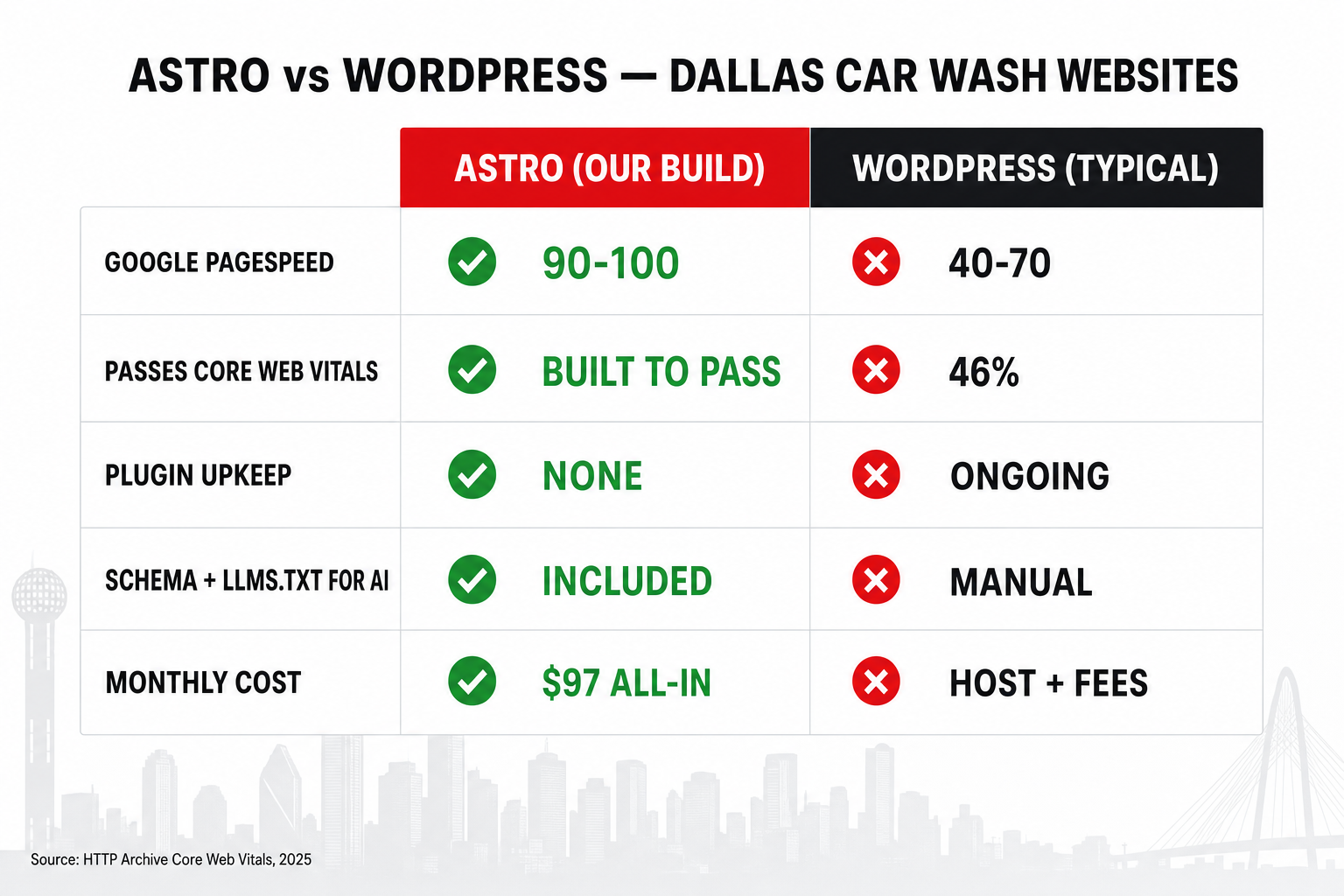
For a Dallas car wash, an Astro-built website beats a typical WordPress site on the one thing that decides whether a driver books: speed. Astro ships almost no JavaScript and serves pre-rendered pages from a global edge network, so it routinely scores 90–100 on Google PageSpeed; WordPress, weighed down by plugins and a database call on every visit, passes Google’s Core Web Vitals on only about 46.3% of the origins measured (HTTP Archive, via Search Engine Journal). In a metro with well over a thousand car washes competing for the same “car wash near me” tap, the faster site wins the member — and the slower one hands them to the wash on the next block.
This is a straight comparison for the Dallas–Fort Worth operator deciding what to build their site on: what “fast” is actually worth in booked washes and members, where WordPress bleeds speed, and how an Astro site closes the leak.
Table of contents
- The short answer for a Dallas wash
- Why website speed decides who books the wash
- Where WordPress loses speed
- What Astro does differently
- Astro vs WordPress: the side-by-side
- The Dallas angle: local search is a speed race
- When WordPress still makes sense
- FAQ
The short answer for a Dallas wash
If your only question is “which is faster and which books more washes,” the answer is Astro — and it isn’t close on the metrics that matter.
WordPress powers a huge share of the web and can be made fast with enough tuning, caching plugins, and a good host. But out of the box, for a busy operator who doesn’t want to babysit a stack, it starts slow and drifts slower every time a plugin is added. Astro is the opposite: it pre-builds your pages to static HTML and sends them from a CDN, so the first paint happens before a WordPress site has finished its database call. For a car wash — where the visitor is standing at a red light deciding whether to pull in — that head start is the whole game.
Why website speed decides who books the wash
Speed isn’t a developer’s bragging right. It’s the difference between a booked membership and a bounce, and the data on that is blunt.
Bounce climbs fast with every second. Google’s analysis of mobile field data found that as a page’s load time grows from one second to three, the probability a visitor bounces rises 32%; from one to five seconds it rises 90%; from one to six, 106%; and from one to ten, 123% (Google/SOASTA). A driver looking for a wash on their phone doesn’t wait — they hit back and tap the next result.
Small speed gains produce real revenue. Deloitte’s Milliseconds Make Millions study, commissioned by Google, tracked 37 brands and found that a mere 0.1-second improvement in mobile site speed lifted retail conversion rates by 8.4% and average order value by 9.2%, and improved bounce rates by 8.3% (Deloitte / Google, via web.dev). Translate that to a wash: faster pages mean more monthly memberships started, more ceramic-coating deposits, more fleet quote forms completed.
Conversion peaks in the first two seconds. Portent’s analysis of first-party site data found the highest conversion rates land in the 0–2 second window, with e-commerce conversion falling from roughly 3.05% at a 1-second load to about 0.67% by 4 seconds (Portent). Every second you add is conversion you give away.
Where WordPress loses speed
WordPress isn’t “bad.” It’s a database-driven CMS that assembles each page on request, and that architecture — plus the plugin culture around it — is where the seconds pile up.
It passes Core Web Vitals less than half the time. Google measures real-user experience with Core Web Vitals — chiefly Largest Contentful Paint (LCP), which should be under 2.5 seconds at the 75th percentile of loads (web.dev). In HTTP Archive’s field data, only about 46.3% of WordPress origins pass all three Core Web Vitals, compared with 70.4% for Squarespace, 74.9% for Wix, and 84.9% for Duda (HTTP Archive, via Search Engine Journal). WordPress’s weak spot is loading (LCP), driven by slow server response time.
Plugin and page-builder bloat. The typical way a wash’s WordPress site gets built — a page-builder (Elementor, Divi), a slider plugin, a booking plugin, an SEO plugin, a security plugin — stacks CSS and JavaScript that the browser must download and run before anything is usable. The median WordPress page already weighs about 2,047 KB on mobile (Web Almanac 2024); every plugin adds to that.
The maintenance treadmill. Plugins need updates, updates break things, and a broken plugin can take the site down or slow it to a crawl. On top of the speed cost, that’s hosting fees, SSL fees, plugin-license renewals, and “let me get you a quote” for a one-line price change — the exact nickel-and-diming operators complain about.
None of this means you can’t make WordPress fast. It means keeping it fast is an ongoing job — one a car wash owner running tunnels and detail bays shouldn’t have to do.
What Astro does differently
Astro is a modern web framework built around one idea: send the browser finished HTML, not a construction kit.
- Static-first, edge-served. Astro pre-renders your pages at build time into plain HTML and serves them from a CDN (in our builds, Cloudflare’s global edge). There’s no database query per visit and no server assembling the page — the response starts almost instantly, which is exactly what LCP rewards.
- Almost zero JavaScript by default. Astro strips out the JS a page doesn’t need and only “hydrates” the interactive bits (a booking widget, a chat bubble) — its islands architecture. Less JavaScript to download and execute means a faster, lighter page, especially on the mid-range Android phones most Dallas drivers are actually holding.
- Speed you can guarantee. Because the output is static and lean, an Astro car-wash site routinely scores 90–100 on Google PageSpeed. That’s the number our Get a Website build guarantees — 90+ on mobile and desktop, often a perfect 100.
- SEO and AEO built in. Clean HTML, proper titles and meta, schema markup, real per-city location pages, plus a correct sitemap, robots.txt, and an
llms.txtso AI answer engines (ChatGPT, Google AI Overviews, Perplexity) can read your wash. Speed and structure are what modern search rewards.
The trade-off is honest: Astro sites are built by a developer, not clicked together in a page-builder by the owner. That’s why the prebuilt website in the snapshot — and our done-for-you Get a Website service — exist: you get the Astro speed without becoming a web developer.
Astro vs WordPress: the side-by-side
Here’s the honest comparison for a Dallas car wash choosing a platform.
| WordPress (typical build) | Astro (our build) | |
|---|---|---|
| Google PageSpeed | ❌ Often 40–70, tuning-dependent | ✅ 90–100, guaranteed |
| Passes Core Web Vitals | ⚠️ ~46% of origins | ✅ Static-first, built to pass |
| Median mobile page weight | ❌ ~2,047 KB | ✅ Lean, JS-minimal |
| Per-city location pages | ⚠️ Plugin/manual | ✅ Built in |
| Schema / meta / llms.txt for AI | ⚠️ Plugin + manual | ✅ Shipped by default |
| Plugin security & update upkeep | ❌ Ongoing, can break the site | ✅ None — static output |
| Hosting / SSL / maintenance fees | ❌ Recurring, add up | ✅ Managed, one flat monthly |
| Editing content | ✅ Owner-editable in dashboard | ⚠️ Via support ticket (done for you) |
| Typical monthly cost | ⚠️ Host + plugins + fixes | ✅ $97/mo all-in |
Read that last-but-one row honestly: WordPress’s real advantage is that the owner can log in and edit anything. Astro trades that for speed and hands-off maintenance — with our service, you send a support ticket and changes ship within days (small ones often within 24 hours). For most wash operators, “I never touch it and it’s always fast” beats “I can edit it but it’s slow and I have to.”
A Dallas driver at a red light, two websites
Searches 'car wash near me,' taps your WordPress site. A page-builder homepage with three plugins and a slider takes 5 seconds to paint on LTE. The light turns green. They close the tab and pull into the express tunnel a block up that loaded instantly.
Same search, your Astro site. The page paints in under a second, the membership pricing and 'Book a Detail' button are visible before the light changes, and they tap through and book — from the driver's seat, before they've even moved.
The Dallas angle: local search is a speed race
Dallas–Fort Worth is one of the most competitive wash markets in the country. Texas has roughly 1,679 car washes — second only to California (MMCG Invest industry overview), and Dallas alone is packed with express tunnels, full-service washes, and mobile detailers all chasing the same drivers. That competition plays out on a phone screen, and it’s decided in seconds.
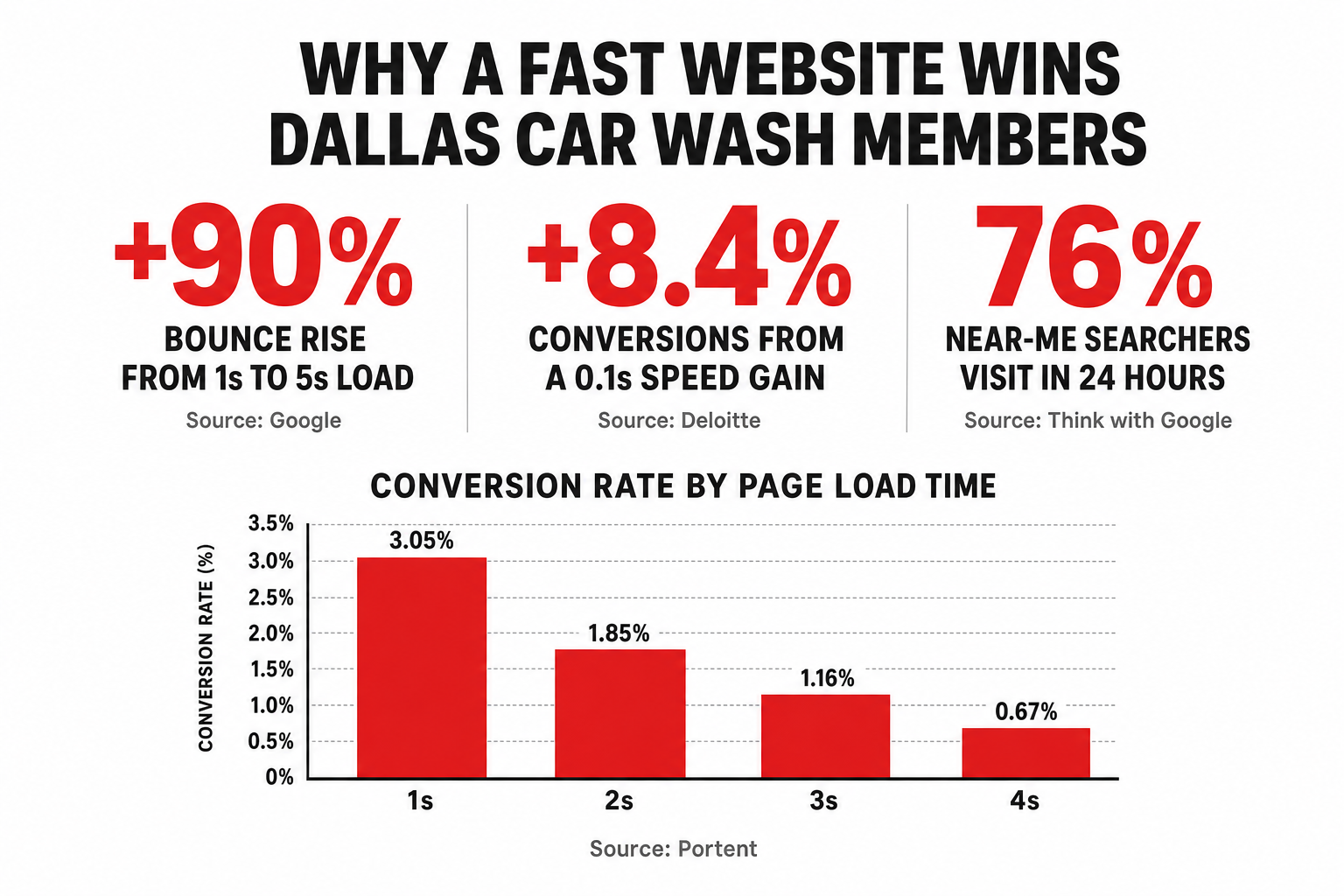
Local search is mobile and immediate. 76% of people who conduct a “near me” search on a smartphone visit a related business within 24 hours (Think with Google), and about 87% of consumers used Google to evaluate local businesses (BrightLocal, 2024). When someone in Plano or Frisco searches “unlimited car wash near me,” the wash whose page loads first and looks trustworthy wins the tap.
First impressions form in milliseconds. Users form an aesthetic judgment of a website in as little as 50 milliseconds (Lindgaard et al., Behaviour & Information Technology), and research long associated with Stanford found roughly 75% of people judge a company’s credibility on its website design (Stanford Web Credibility Project). A slow, dated WordPress site quietly tells a Dallas driver your equipment and detailing are behind the times too — before they’ve read a word.
When WordPress still makes sense
Keeping this honest: WordPress is the right call in a few cases.
- You have an in-house person who lives in the dashboard. If someone on staff genuinely enjoys editing pages, running updates, and tuning caching, WordPress’s owner-editability is a real perk.
- You need a specific plugin ecosystem. A complex membership, e-commerce, or forum feature that only exists as a mature WordPress plugin can justify the platform — though most wash needs (booking, memberships, reviews) are better served by purpose-built car-wash automation than a stack of plugins.
- You already have a fast, well-maintained WordPress site. If yours passes Core Web Vitals and scores 90+, don’t rebuild for the sake of it — fix what’s actually slow.
For everyone else — the operator who wants a site that’s fast on day one, ranks in DFW, and never demands another plugin update — Astro is the better foundation. The speed isn’t a nice-to-have; it’s the difference between the booked wash and the bounce.
FAQ
Is Astro really faster than WordPress for a car wash website?
Yes, structurally. Astro pre-renders pages to static HTML and serves them from a CDN with almost no JavaScript, so the first paint happens almost instantly. WordPress assembles each page from a database on request and typically carries plugin and page-builder overhead — its median mobile page weighs about 2,047 KB (Web Almanac 2024) and only ~46.3% of WordPress origins pass Google's Core Web Vitals (HTTP Archive). An Astro car-wash build routinely scores 90–100 on Google PageSpeed.
How much does website speed actually affect car wash bookings?
A lot. Google found the probability a mobile visitor bounces rises 90% as load time goes from 1 to 5 seconds. Deloitte's study for Google found a 0.1-second speed improvement lifted retail conversions 8.4% and average order value 9.2%. Portent found conversion rates roughly halve between a 1-second and 4-second load. For a wash, that's the gap between a booked membership or detail and a driver who taps back to Google.
Can't I just make my WordPress site fast with a caching plugin?
You can improve it, but keeping it fast is ongoing work. Caching plugins, image optimizers, and a premium host help, yet every new plugin, update, and page-builder element adds weight, and a bad update can slow or break the site. Astro is fast by architecture — static output means there's no per-visit database call to speed up in the first place.
What does a fast car wash website cost with your service?
Our Get a Website service builds your wash's site on Astro for $497 one-time plus $97/month. The monthly covers managed Cloudflare hosting, your domain, SSL, and maintenance — no separate hosting, plugin, or update fees. You pay only the monthly up front; the one-time fee is charged after the site is live and you're happy (about 10 working days). Auto-blogging is available at $197/month total.
Will an Astro site rank for 'car wash near me' in Dallas?
Speed is a ranking and conversion advantage, and we pair it with the structure that wins local search: per-city location pages (Dallas, Plano, Frisco, Arlington and more), local schema, and a clean sitemap, robots.txt, and llms.txt so both Google and AI answer engines can read your wash. With 76% of near-me searchers visiting a business within 24 hours, a fast, well-structured site is how you capture that intent. We guarantee your site starts ranking in your area within 3–5 months.
I can edit my WordPress site myself — do I lose that with Astro?
You trade dashboard self-editing for speed and zero maintenance. With our done-for-you Astro service you request changes via a support ticket (up to 10 per month); most updates ship within 5 days and small ones often within 24 hours. For operators who'd rather run the wash than maintain a website, hands-off-and-always-fast beats editable-but-slow.
About the author
Wyatt Coleman is a Local Demand & Fleet Acquisition Specialist based in Kansas City, Missouri. He grew up around his family’s full-service wash in the Midwest and now helps independent operators win the deals they leave on the table — the after-hours calls, the weekend surges, and the local searches that fill empty bays. He’s happiest turning a “car wash near me” tap into a signed membership.
Related reading
- Car Wash Local SEO: How to Rank in the Google Maps 3-Pack
- Car Wash Online Booking: The 24/7 Booking Playbook
- AI Receptionist for Phoenix Car Washes: Stop Losing Members to Missed Calls
- How to Get More Car Wash Customers: The Local Growth Playbook
- 7 Car Wash Membership Automations That Pay For Themselves in 30 Days
Sources & further reading
- Google/SOASTA — Mobile page speed benchmarks (bounce probability +32% at 3s, +90% at 5s, +106% at 6s, +123% at 10s)
- Deloitte / Google — Milliseconds Make Millions (via web.dev) (0.1s speed gain: +8.4% retail conversions, +9.2% AOV)
- Portent — Site speed is (still) impacting your conversion rate (conversion by load time, 1s vs 4s)
- HTTP Archive — WordPress vs everyone: Core Web Vitals (via Search Engine Journal) (WordPress ~46.3% CWV pass rate)
- HTTP Archive — Web Almanac 2024: Page Weight (median WordPress mobile page ~2,047 KB)
- Google / web.dev — Largest Contentful Paint (good LCP < 2.5s)
- Think with Google — Mobile search to store (76% of near-me searchers visit within 24h)
- BrightLocal — Local Consumer Review Survey 2024 (~87% use Google to evaluate local businesses)
- Lindgaard et al. — 50ms first impression (Behaviour & Information Technology)
- Stanford — Web Credibility Project (~75% judge credibility on design)
- MMCG Invest — U.S. car wash & detailing industry overview 2025 (Texas ~1,679 car washes, 2nd nationally)