
It is the second of the month and you are reconciling two numbers. Your merchant deposit for the unlimited wash club is up again, more members than last year. Then you open the EverWash statement, and it is up too, by almost the same shape, because the number EverWash charges is a slice of the first one. Your club grew, and so did the slice. Nobody printed that trade on a pricing page: EverWash, like most of this category, prices on a call.
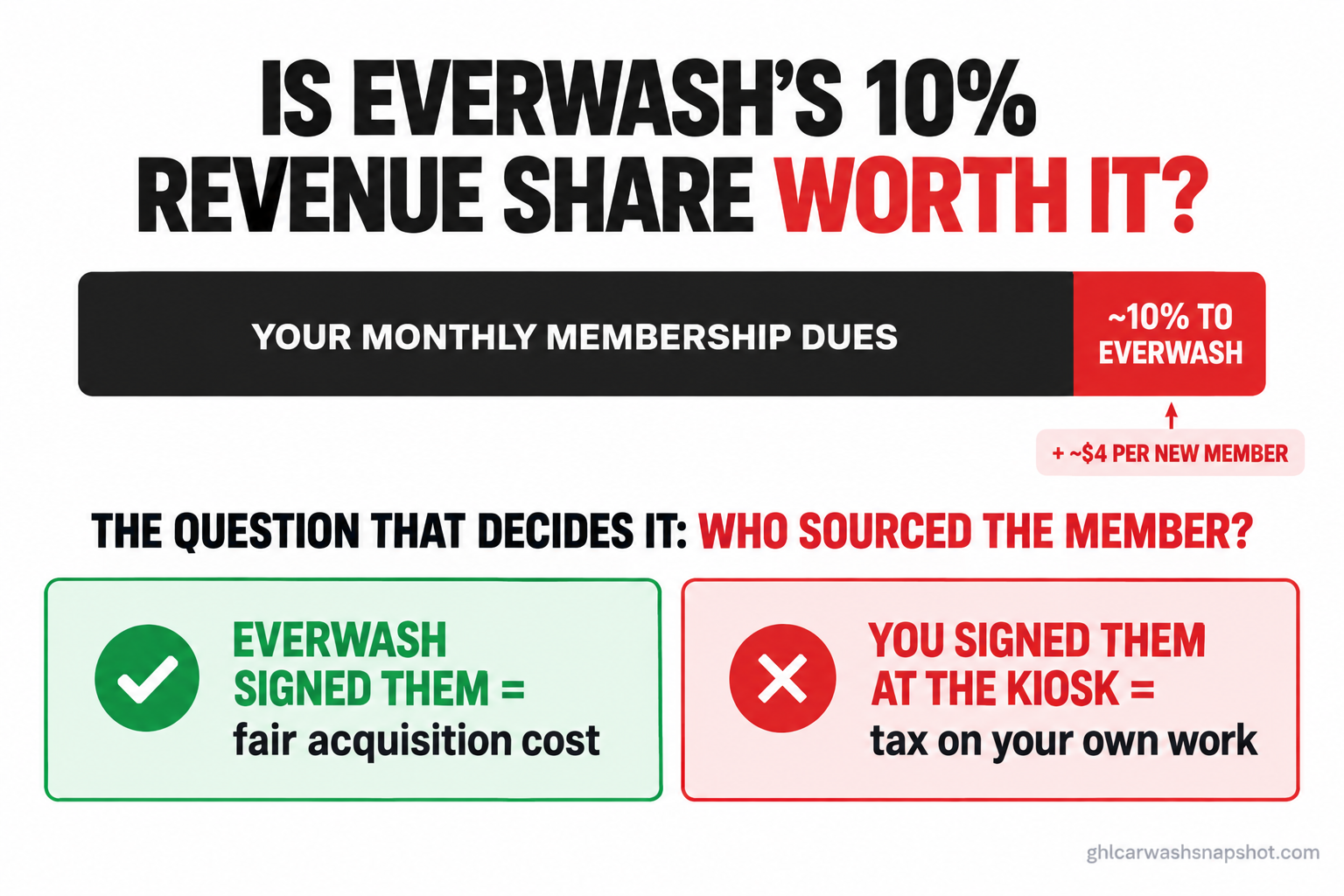
Here is the honest answer before the detail. EverWash charges a reported revenue share around 10% of your membership dues, plus a small per-new-member fee, plus the usual card processing. Whether that cut is worth it comes down to one question, and it is not “how big is the percentage.” It is “who signed the member?” If EverWash’s app and network bring you drivers you would not have converted on your own, the 10% is a customer-acquisition cost that can pay for itself. If you sign most members yourself at the kiosk, it is a growing tax on your own work, and a flat-fee system almost always wins once your club is past a few hundred members. This teardown gives you the reported numbers, the break-even math, three scenarios, and the questions to ask before you sign.
Table of contents
- What EverWash actually is (and is not)
- What EverWash actually costs you
- The one question that decides it: who sourced the member?
- The break-even math, in plain numbers
- Three real wash scenarios
- How the revenue-share model breaks on you
- Steal these: the questions to ask and the decision worksheet
- The flat-cost alternative
- Objections, answered
- FAQ
What EverWash actually is (and is not)
Start here, because the name confuses people. EverWash is not your point-of-sale and it does not own or run your wash. It is a membership program and consumer app that sits on top of the wash you already operate: it signs drivers up to an unlimited plan, bills them monthly, markets to its own member base, and takes a cut of the dues (EverWash for wash owners). The company is clear in its own materials and its Better Business Bureau profile that it owns the app and membership service, not the physical washes (BBB profile).
That matters for the price. Unlike a per-unit POS or an analytics layer like Rinsed, EverWash charges a share of the recurring revenue it helps collect, bringing a member-acquisition angle the others lack: its app already has drivers in it, marketed as a network rather than your single location. The pitch is “we grow your membership base and only make money when you make money,” genuinely true for some washes, and this post exists to tell you which ones. Its own blog puts the average member at $32 a month for about 11.5 months (EverWash blog).
What EverWash actually costs you
EverWash does not publish a live rate card, so every figure here is reported from operators and review sites, some of it a few years old. Get your own numbers in writing first.
The most detailed operator account on the Car Wash Forum breaks the cost into three parts: roughly 4 to 5% in card swipe fees, about 10% to EverWash, and around $4 per new member signed (Car Wash Forum). Those operators call the 10% the real downside.
One honest adjustment before you panic at “nearly 20% all-in.” The card swipe fees apply no matter who runs your billing, so the swipe line is the cost of accepting cards, not an EverWash cost.
The one question that decides it: who sourced the member?
A revenue share is fair in exactly one situation: when the vendor brings you a customer you would not otherwise have had. If EverWash’s app puts a member on your plan who never would have signed at your kiosk, 10% of their dues is a commission on found money, the same logic as a lead-gen fee. It is a straight tax in the opposite situation: when a driver pulls up, your attendant pitches the plan, and they sign on your pay station. EverWash did not source that member, you did, and 10% of their dues every month is a percentage on your own staff’s work. Because nearly 90% of members plan to renew (ICA Q1 2026), that is not a one-time cut. It recurs for years.
The same 10%, two completely different deals
EverWash sourced the member: 10% is a commission on revenue you would not have had. Fair. You only pay when they win you a customer.
You sourced the member at the kiosk: 10% is a recurring tax on your own staff's work, charged every month the member stays. This is the expensive case, and it is most members at most washes.
So the honest test before you sign is one estimate: what percentage of the members on EverWash would you have signed anyway? Most established washes with a staffed lane and a website convert the majority themselves, so the share is mostly tax. A brand-new site with no list and empty bays is the opposite, and that is where EverWash’s acquisition engine earns its 10%.
The break-even math, in plain numbers
Forget acquisition for a second and just compare the dollars. EverWash’s share is a percentage of dues, so it rises with your revenue and never flattens, while a flat system costs the same at 100 members or 10,000. So the break-even point comes shockingly early.
Take a GoHighLevel Unlimited plan at $297 a month (GoHighLevel pricing). EverWash’s 10% share equals $297 when your monthly dues hit $2,970, about 93 members at the average $32. Above that, the share alone costs more than a flat, member-count-independent system, and the gap widens every month you grow.
The per-member fee only widens the gap: at roughly $4 per new member, a wash signing 300 a year pays another $1,200 on top of the share, none of which lands on a flat system. A 10% share feels invisible at 120 members and is the single largest line in the software budget at 1,200.
Three real wash scenarios
The same framework gives three different answers depending on the size and the stage of your wash. Here is how it actually plays out.
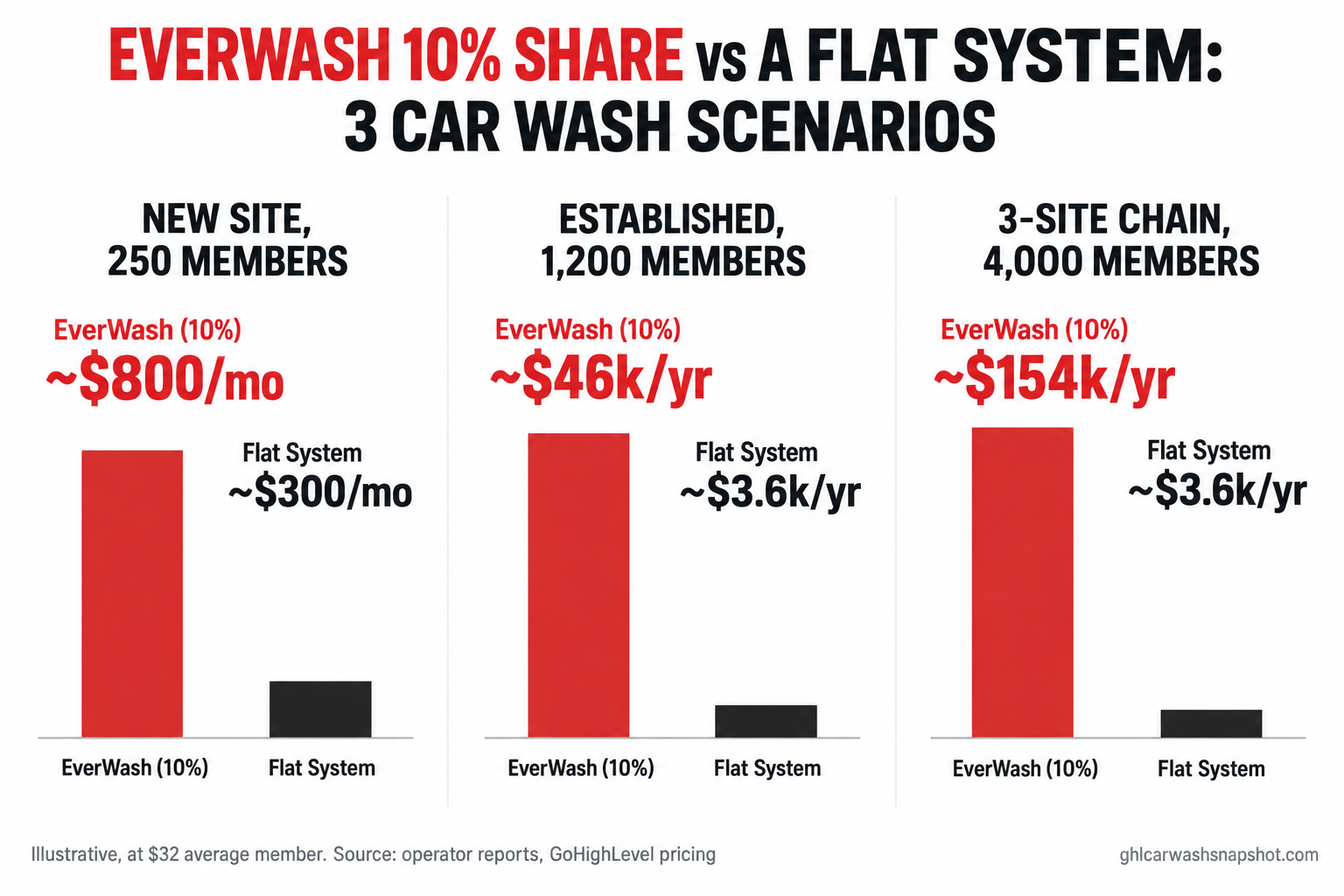
Scenario one: the brand-new single site, still filling bays. You just opened, no email list, quiet weekdays, nobody on staff who can run a membership funnel. This is EverWash’s best case: its app has drivers in it, and a chunk of the members it signs genuinely would not have found you yet. Say it brings you to 250 members at $32, or $8,000 a month in dues, so the 10% share is $800. If even half of those members are truly EverWash-sourced, you are paying $800 to acquire revenue that did not exist, which is defensible while you ramp. Re-check the day your own marketing carries the signups.
Scenario two: the established single or two-site wash, 1,200 members. This is where most operators get quietly overcharged. 1,200 members at $32 is $38,400 a month in dues, so the 10% share is $3,840 a month, about $46,000 a year, climbing with every renewal. By now you have a staffed lane, a website, and regulars who sign at the kiosk, so EverWash sources a small minority of these members. You are paying $46,000 a year, most of it tax on your own work, against a few thousand for a flat system, and failed-card recovery now saves you more than any acquisition channel.
Scenario three: the three-site chain, 4,000 members. 4,000 members at $32 is $128,000 a month in dues, so a 10% share is $12,800 a month, roughly $153,600 a year, your largest software expense by a wide margin. At this scale almost all of your growth is your own brand and locations, so the share is nearly pure tax, and operators price out owning a flat system outright. Use a churn and LTV model to put the five-year figure next to the one-time cost.
Illustrative math on reported ~10% of dues (operator reports) at a $32 member. Renewal: ICA Q1 2026 Pulse.
The pattern is the same across all three: EverWash is cheapest exactly when you are smallest, which is also when it is easiest to join and hardest to leave. Membership revenue is up 10.4% while retail is down (Rinsed Q2 2026), and the point of chasing members is to keep that growing margin, not hand a tenth of it back.
How the revenue-share model breaks on you
Here are the failure modes specific to a revenue share.
It punishes your best months. The month you run a great promo and sign 200 members is the month your EverWash bill spikes hardest. Your cost is highest exactly when you are winning, which is backwards: the model is built to grow with you, and growth is the expensive direction.
It owns the member relationship, not you. When a vendor runs the app, the billing, and its own network, member loyalty can attach to the app, not your brand. If you ever leave, who keeps the member and their card-on-file token is where switches die. Get data-portability and exit terms in writing first.
It has every incentive to keep members on the books. A share-of-dues vendor earns more the longer a member stays, including ones who want to cancel, which can quietly push toward cancellation friction that lowers churn on paper and raises your legal exposure. Your club is an auto-renewing subscription governed by state auto-renewal laws and the FTC Act, not the vacated federal click-to-cancel rule, so clean cancellation is your responsibility no matter who runs the billing (the auto-renewal breakdown). And because you still police the plan against sharing, you carry the abuse cost and pay the percentage both.
Steal these: the questions to ask and the decision worksheet
Copy these into your notes before you sign, or before you decide to leave.
The five questions to ask EverWash on the call (get answers in writing):
- “What is the exact revenue share, and is it on gross dues or net of refunds and chargebacks?”
- “What is the per-new-member fee, and does it recur or is it one time?”
- “How do you attribute which members came from your network versus my own kiosk, and can I see that split monthly?”
- “If I leave, do I get a full export of members, plans, billing dates, and card-on-file tokens, and is there a fee or notice period?”
- “What is the contract length and the early-termination cost?”
The decision worksheet (five minutes with your own numbers):
- Members on EverWash today: ______
- Monthly dues total (members x average dues): $______
- EverWash monthly cost (10% of dues + ~$4 x new members): $______
- Honest estimate: what % of these members would you have signed yourself? ______%
- Above ~60%, most of your share is tax, so price a flat system. Below ~40% with under-filled bays, the acquisition may be worth it for now.
The switch checklist, if you decide to move off a revenue share:
- Export members, plans, billing dates, and card-on-file tokens (confirm token portability, where switches fail).
- Reconcile active versus failed-payment members so you do not import a churn problem.
- Rebuild the failed-card dunning sequence before go-live.
- Run a parallel week, old and new billing side by side, then cut over.
The flat-cost alternative
The alternative to a percentage is a system you pay a fixed amount for, that runs the same machine (signup, recurring billing, failed-card recovery, win-back, reviews, fleet) and costs the same at 200 members or 12,000. The GHL Car Wash Snapshot is a prebuilt version of exactly that, installed for washes, so your cost is a one-time build plus a flat GoHighLevel plan (pricing here), not a slice of your dues. You keep the member relationship and the data, and your margin stays yours. For the full three-way picture of what every vendor charges, see what car wash membership software actually costs in 2026, and for the closest head-to-head, Rinsed vs GoHighLevel for car washes.
Objections, answered
“A revenue share feels fair, because EverWash only makes money when I make money.” It feels fair and is the most expensive model once you are winning, and the fairness depends entirely on who sourced the member. On members you sign yourself, “they only win when I win” means “they take a cut of my own work, forever.”
“EverWash runs the whole thing for me. Isn’t that worth 10%?” Maybe, for a brand-new site with no list. But “run for you” and “flat fee” are not mutually exclusive: a prebuilt flat system is also run for you, and a GoHighLevel VA can operate it without the percentage. The choice is done-for-me at a flat cost versus done-for-me at a growing cut.
“I already use EverWash and it is fine. Why change?” If your bays are under-filled and EverWash is genuinely sourcing your members, do not change for its own sake. But pull the EverWash-specific line off your statement and annualize it. If it is five figures and you convert members yourself, that is a recurring cost a flat system would erase.
“Won’t moving off EverWash cost me members?” Only if you let the relationship and the card tokens live inside its app, which is why exit terms are question four on the call. Port the tokens cleanly and members never notice a billing change, and the automations that convert retail customers into members run the same on a flat system, just without the percentage.
The honest verdict
Back to that statement on the second of the month. The EverWash line grew because your club grew, the model working as designed. The question is whether it is working for you or on you.
There is no universal answer, because EverWash is reasonable in one situation and backwards in another. A brand-new, under-filled site that needs members more than margin and has nobody to run a funnel can make a revenue share pay for itself while it ramps. An established wash with a few hundred members, a staffed lane, and any plan to grow is paying a tax on its own work that gets heavier every month.
So do not score EverWash on the size of the percentage. Score it on attribution and on size. Estimate how many members you would have signed anyway, annualize the EverWash-specific cost, and put both next to what a flat system costs. For most washes past their first year, that one page of math makes the decision. Make sure the software running your fastest-growing revenue is not quietly taking a bigger slice every month you succeed.
FAQ
How much does EverWash cost a car wash owner?
EverWash does not publish a rate card. Operators report a revenue share around 10% of dues, plus roughly $4 per new member, plus normal card processing of 4 to 5% that you pay on any platform. The EverWash-specific cost to compare is the ~10% share plus the per-member fee, and these figures are reported and older, so confirm them in writing.
Is EverWash's revenue share worth it?
It depends on who sources the member. If EverWash's app brings you drivers you would not have converted yourself, the 10% is a reasonable acquisition cost. If you sign most members at the kiosk, it is a recurring tax on your own work, and a flat-fee system is almost always cheaper once you pass roughly 90 to 100 members.
At what point does a flat system beat EverWash's 10%?
Very early. Against a $297/month flat plan, the 10% share equals $297 when monthly dues reach about $2,970, or roughly 93 members at a $32 average. Above that the flat system is cheaper, and the gap widens every month because the share has no ceiling.
Does EverWash own my car wash or my members?
No. EverWash owns the membership app and billing service, not your physical wash, but the customer relationship and card-on-file tokens can attach to its app rather than your brand. Get data-export and token-portability terms in writing before signing.
What is the cheapest way to run a car wash membership program?
For a brand-new, under-filled site with no marketing, a revenue share can be cheapest to start. Past a few hundred members, a flat or one-time model wins because it does not climb with member count. The GHL Car Wash Snapshot runs the full machine for $997 one-time plus a flat GoHighLevel plan.
Related posts
- What Car Wash Membership Software Actually Costs in 2026: Rinsed vs Washify vs EverWash
- Rinsed vs GoHighLevel for Car Washes: Which CRM Should Run Your Wash Club?
- Silent Card Churn: The Hidden Killer of Every Unlimited Wash Club
- Car Wash Membership Churn and LTV Calculator: Know Your Real Numbers
- Car Wash Membership Auto-Renewal Laws in 2026: What Actually Applies